


Nina Childress
Waving a magic wand to elevate painting
“The Académie des Beaux-Arts is quite unconventional. It allows me to approach the sword as something other than a weapon.”
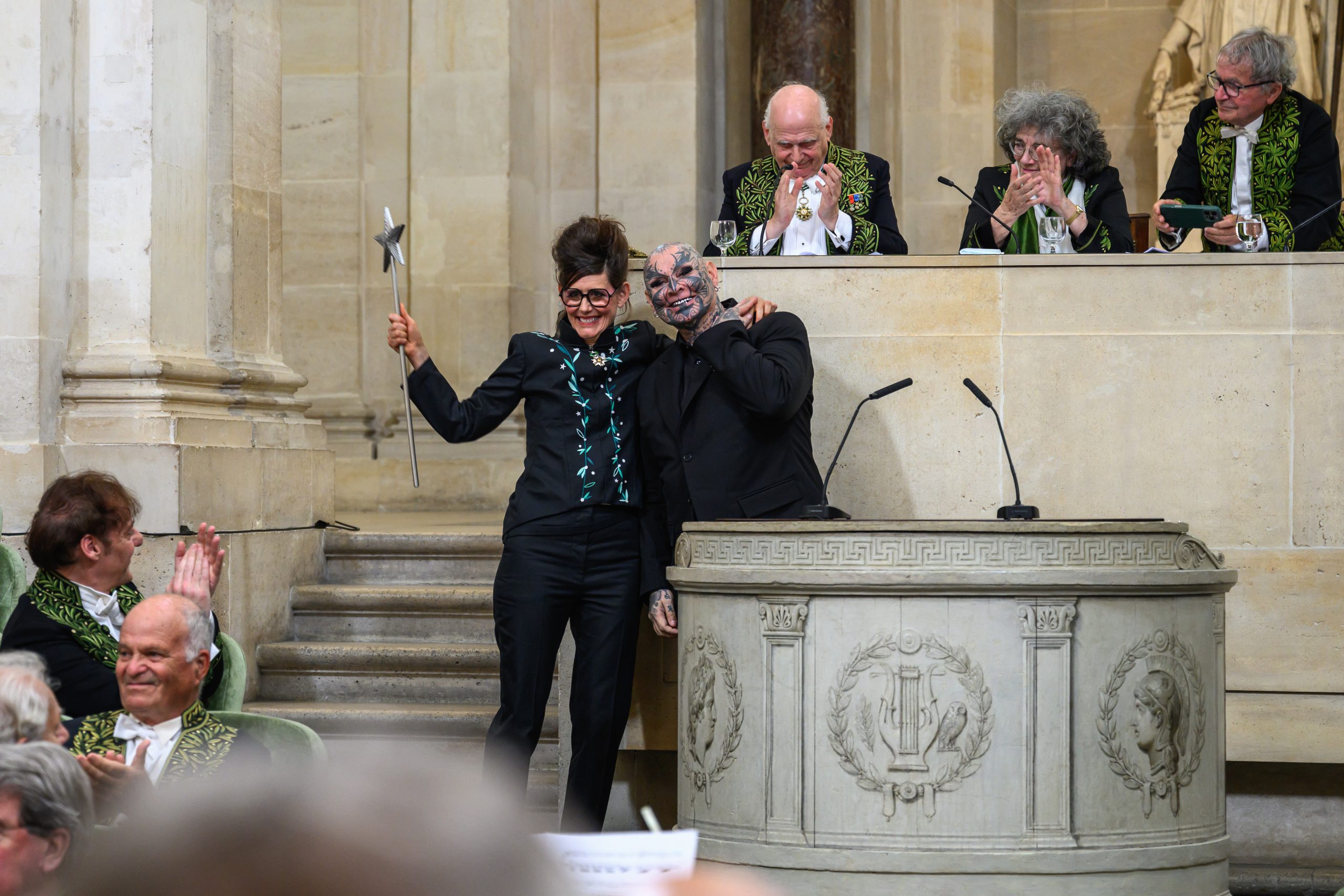
Last Thursday, June 25th, Franco-American painter Nina Childress became an official member of the Académie des Beaux-Arts in Paris. True to her inimitable style and punk attitude, the artist made an intervention speaking for her political engagements and conveying a strong message. After the ceremony, we had the pleasure of chatting with her to find out more about her choice of sword and outfit, which embody Childress’ vision and herald a wind of renewal for the Académie and painting at large.
Congratulations for your nomination to the Académie des Beaux-Arts! During the ceremony, we noticed that your academician’s sword was quite unusual… Can you tell us more about it?
Nina Childress:
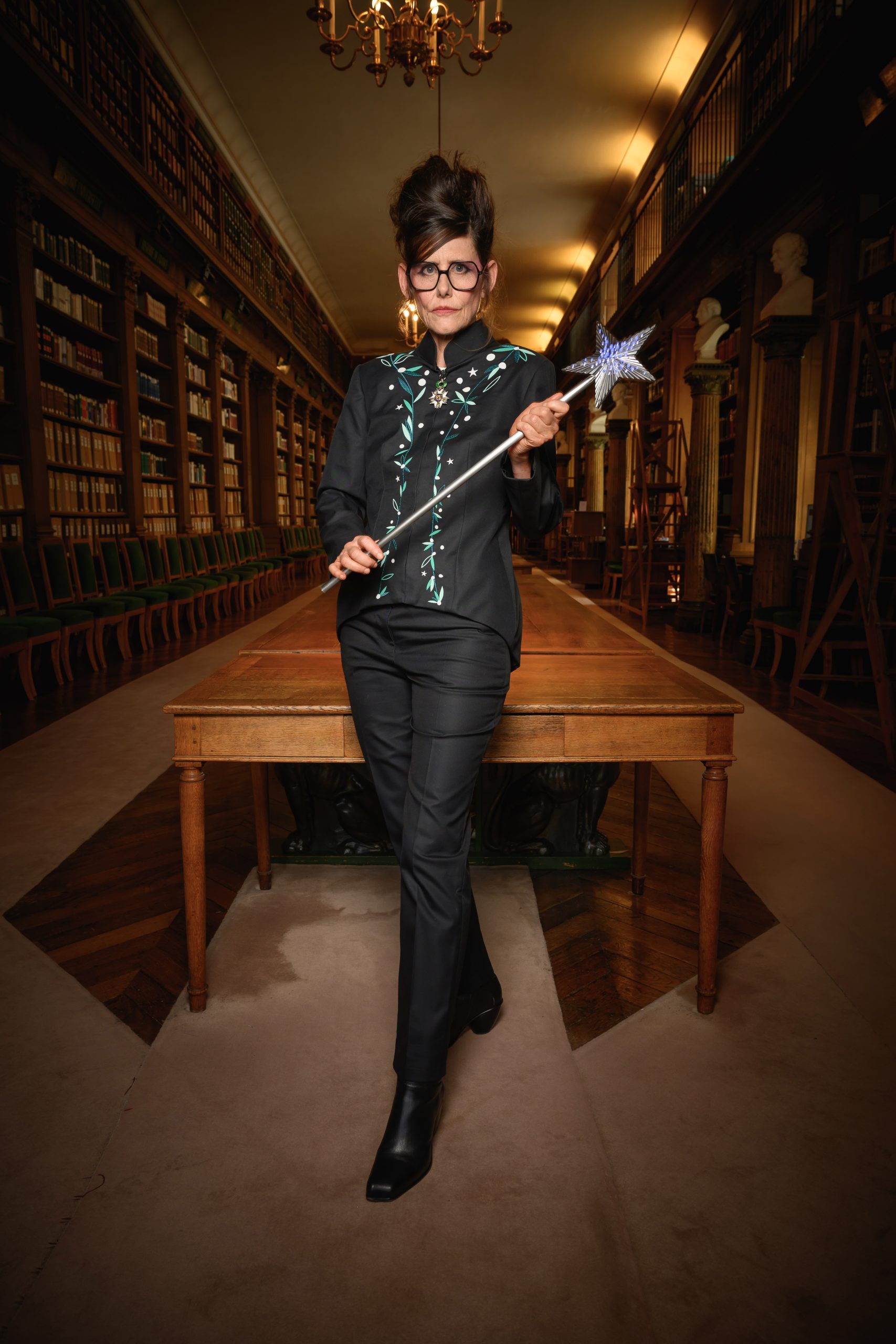
The Académie des Beaux-Arts is the most unconventional of the Institut’s branches. It opens up the possibility of approaching the sword as something other than a weapon. I came up with the idea of asking Jean-Luc Verna to design me a magic wand with ultra-violet LEDs, which would light up the phosphorescent thread embroidery.
Your academic attire also carries great symbolism…
Nina Childress:
I wanted it to be a feminist manifesto. I teamed up with the participatory design studio About a Worker, which invited the Maison des Femmes de Paris, a non-profit organisation for women, to create the embroidery designs. It was about looking beyond the traditional luxury fashion industry.

Last year, Eva Jospin, Valérie Belin, Marjane Satrapi, and Tania Mouraud joined the Academy, increasing the proportion of women within its ranks. Does your induction further demonstrate the Academy’s commitment to gender parity?
Nina Childress:
Tania and I were the first two women elected to the painting section, the last stronghold exclusively run by men. That was also one of the reasons I chose to run. As in many institutions in France, there is still important work to be done regarding inclusion at the Académie.
For those unfamiliar with how such an institution operates, what does being a member of the Academy entail? And what are your personal goals in your new role?
Nina Childress:
What’s particularly stimulating for a hyperactive person like me is that the position is “for life”. We meet every Wednesday to discuss topical issues in the art scene, to allocate fellowships, prizes and residency grants. We can also share our views with the Head of State, for example, by voicing our concerns over budget cuts in the cultural sector. For my part, I hope that I can contribute to promoting painting in a clever way, supporting cutting-edge and unconventional artists.
Your work is currently exhibited at the Centre Pompidou-Metz as part of the exhibition ‘Copistes’. How did you choose which works to copy? And how did you bring your own personal touch?
Nina Childress:
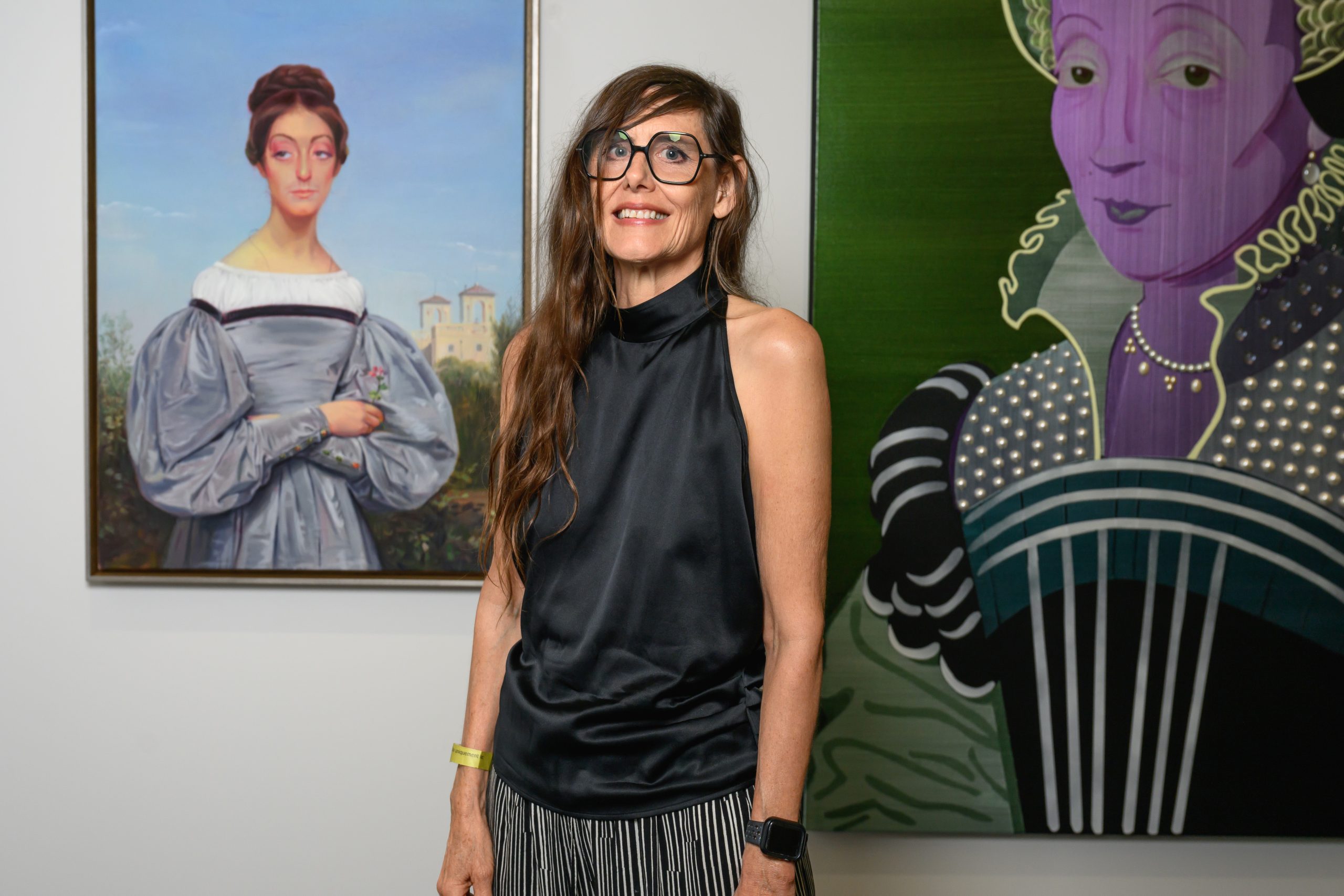
I submitted two proposals, quite different from each other. The first one was to make an almost identical copy of a rather pompous nineteenth-century painting by Horace Vernet, the portrait of his daughter. She instantly reminded me of the late Pascale Ogier, with her large, prominent eyes. I only made slight adjustments to her facial features, just enough to make Pascale stand out.
The second canvas is a large-scale replica of a small painting by François Clouet, which depicts a very serious medieval lady. I stuck to the original in terms of drawing, as precise as a scalpel cut, but used pigments that shift color depending on the viewing angle and glued multiple beads to symbolise the pearls in her dress. The final look is still dark and intricate, yet rendered with contemporary means.

To some extent, the exhibition deals with the tradition of copying as a learning method. What did you learn by working on these paintings?
Nina Childress:
I often revisit my own work, reinterpreting it through different styles or techniques. But in order to follow the specific instruction to “copy,” I had to work within parameters I hadn’t chosen myself: using a color palette I had long abandoned for the Vernet, and adopting an austere drawing style for the Clouet.
You have a rather unconventional learning background. Although you attended a renowned Paris art school, you had a career as a punk singer before devoting yourself entirely to painting, and you describe yourself as self-taught. How has this path shaped your practice?
Nina Childress:
I never stopped painting, even when I was a singer. Back in the days, I was too restless to attend school and too stubborn to follow advice. Working held me back in the beginning: It took time to make a breakthrough, and I had to be constantly challenging myself. Looking back, however, it may have been a blessing in disguise – I wasn’t pushed into a box too early on. This is what I wanted to show by publishing my catalogue raisonné, 1081 paintings, which also features a biography written by Fabienne Radi.
What are your upcoming projects?
Nina Childress:
A solo show in Paris featuring new paintings created with chameleon pigments. This will be my second solo show at the Art : Concept gallery, which will open to the public on October 16th. I’m currently working on a large canvas that will bear the title of the exhibition: ‘Casting’.
Interview by Cristina López Caballer
Photos: Michaël Huard


