


Xie Lei
Meeting the 2025 Prix Marcel Duchamp laureate
“I am trying to draw the viewer into another world, to give them the impression of diving into and participating in the painting.”
Born in 1983 in Huainan, China, Xie Lei first studied at the Central Academy of Fine Arts in Pekin before moving to Paris in 2006 to complete its formation at the Beaux-Arts de Paris. Now renowned for his sensible painting, spectral silhouettes and mysterious atmospheres, he was awarded the 2025 Prix Marcel Duchamp last October. Currently exhibiting at the Musée d’Art Moderne in Paris, Say Who met him to talk about his work and his inspirations.
You arrived in France in 2006 to study at the Beaux-Arts, went on to obtain a doctorate, and now you just won the prestigious Prix Marcel Duchamp. What does it represent for you?
XIE LEI:
It’s incredible! I am obviously very happy about this award, which was given to me in a country where I chose to study and settle.
I am very grateful to the members of the ADIAF ((Association for the international diffusion of French Art) for allowing me to be nominated alongside three excellent artists for the 2025 Prix Marcel Duchamp. The exhibition at the Musée d’Art Moderne in Paris was already a wonderful opportunity, but winning the prize is such a great joy! The jury was made up of renowned professionals, and I am honoured that they chose to acknowledge my painting.
I know that this award brought great pride to all those who support my work: my family, my friends, my galleries, and especially the Parisian gallery Semiose. Shared joy is double joy!
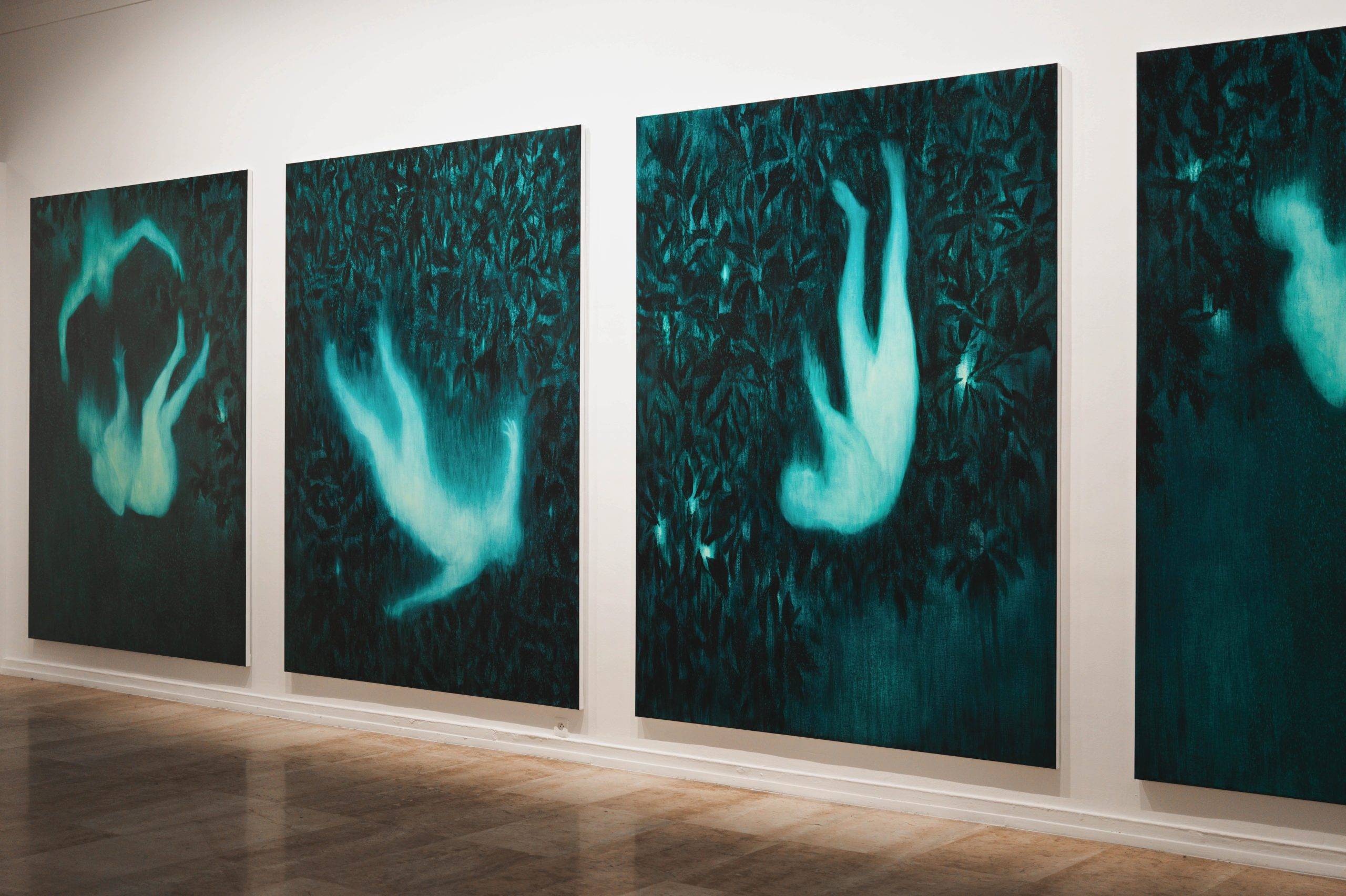
For the occasion, you presented a special series of seven striking paintings on the theme of free fall. What drew you to this topic?
XIE LEI:
The concept of falling originally stems from a very personal anxiety, a phobia of water, and more specifically, jumping into it. I read extensively while painting these pieces, including Gaston Bachelard’s work on dreams and falling, and the dream of dropping into an abyss. Speaking of falling, I am also fascinated by the myth of Icarus, whose wings melted as punishment, and so on. But I also see an imaginary dimension to these falls, one that is bright, gentler, perhaps less violent: a form of levitation rather than a fall, but nonetheless somewhat unsettling. Overall, ambiguity is what speaks to me.
Your characters often seem to be in a state of emotional transition. Why are you drawn to this instability?
XIE LEI:
In a long interview we conducted with Neil MacGregor and published by Semiose (Face to Face, October 2025), he pointed out a state somewhere ‘between dream and nightmare.’ About ten years ago, my work was considered dreamlike, and described as such. However, I make a point of avoiding representing my dreams in my paintings. I’m more interested in time being stretched out, or, on the contrary, crystallised: meaning, when the action is happening, which the English language describes really well with its -ing form. With this ‘in the process of’ moment – like in Poussin’s paintings or in tragedy – it’s not the outcome that matters, rather what’s happening right now. It’s that moment when time stands still.

You often work in thematic cycles, building your pieces around a word, a concept, or an action. Where do you get your inspiration?
XIE LEI:
I paint with my imagination. Sometimes it comes from a very ordinary image, seen in newspapers or elsewhere. Other times it comes from films, whose images leave a powerful impression on my imagination. But that’s only the starting point; I later stray from the original images. Sometimes these characters represent me, as I look at myself in the mirror to draw their silhouettes. I fill many notebooks with illegible and somewhat messy sketches. What interests me, what I seek, is compositional balance and the strength of the line.
How do you know when a series has come to an end, that it is time to move on to another area of research?
XIE LEI:
I believe that my painting is a continuous quest about form. This search encompasses a number of other questions: what is painting? What else can be done with paint? What are the limits of painting? Ultimately, these questions could be explored throughout my entire life, and I will only ever come close to answering them!
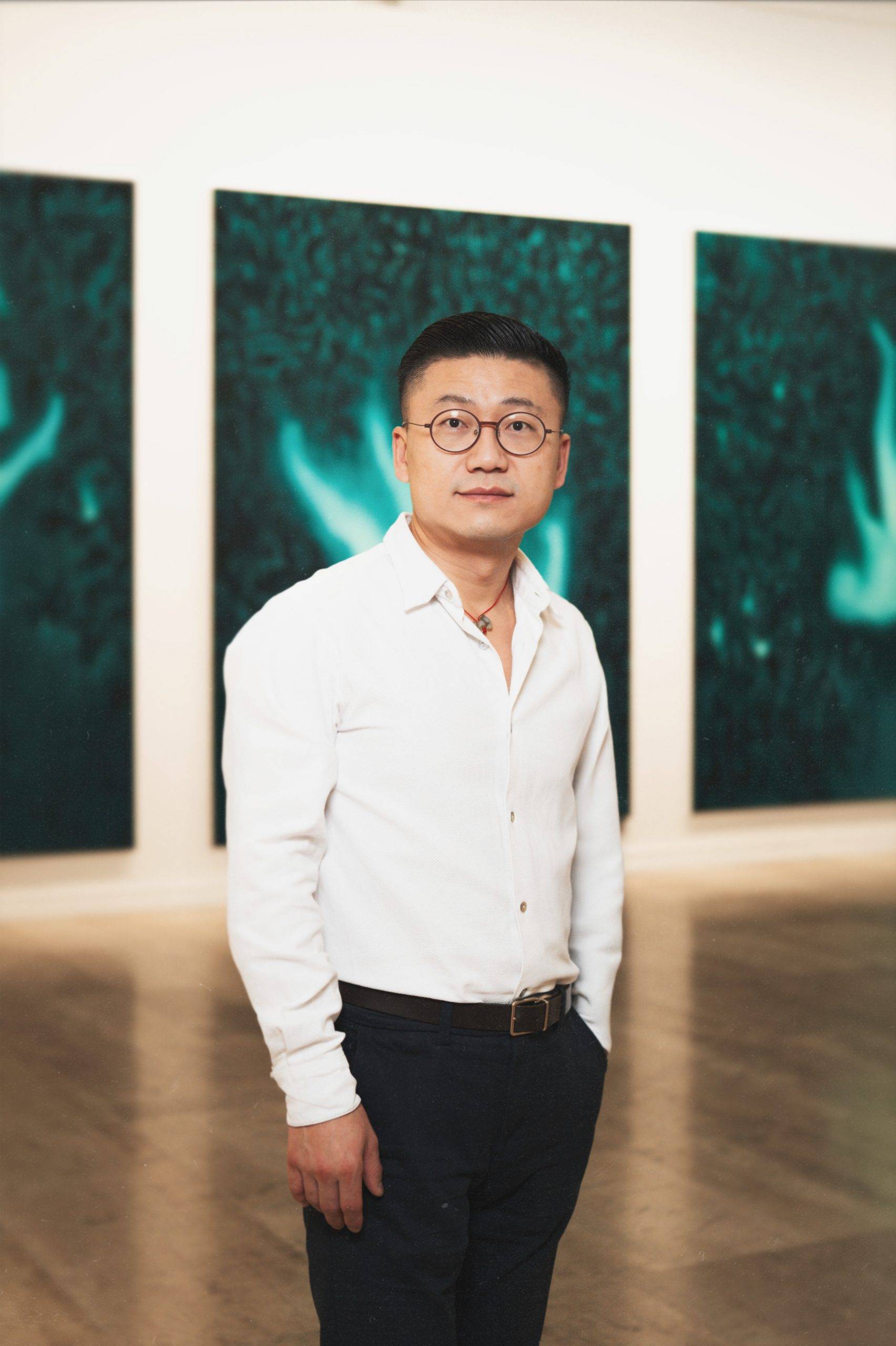
Your paintings shift between intimacy and universality. Is this balance intentional? How do you work with this tension?
XIE LEI:
Absolutely, and you’ll notice it is also difficult to guess the gender of my characters. They are human, that’s all. It is human beings, living beings, that interest me. My paintings are about intimacy, about what I think, what I see, what I imagine, what happened in the past that has stuck with me. All of this has perhaps become a chimera of myself, a mirror of many reflections, which, once transformed through painting, attain a universal dimension.This is one of the great strengths of painting, which makes it an unrivalled, ever-relevant medium. By creating my own pictorial language, narrowing down my palette, trying to use as few elements as possible to say as much as possible, and exploring poetic dimensions that go against the grain of this era, I believe that this is how my subjects become universal.
You usually depict ghostly figures, who are almost unrecognizable due to their wavering outlines. In this sense, do you consider your painting to be figurative?
XIE LEI:
My painting inherits a combination of Western and Chinese influences, and I believe this explains the uncertainty between figuration and abstraction. This suits me very well, as I am not seeking to overcome this uncertainty. The question I ask myself is: how can I share feelings and sensations with the viewer through my brushstrokes? I believe that I am trying to draw the viewer into another world, to give them the impression of diving into and participating in the painting.
This exploration of instability was also evident in the exhibitions Mort heureuse (Semiose Gallery) and Désarroi (Sies + Höke Gallery). What form will it take in your next exhibition, which is set to open in June 2026 at the Denys-Puech Museum?
XIE LEI:
The room in which I will be exhibiting at the Denys-Puech Museum is very inspiring. It is perfectly symmetrical, with green marble colonnades on either side. I want to create a mirror effect, a bit like shimmering water. But unlike my exhibition at the Louis Vuitton Foundation in 2023, where I used mirrors directly on the opposite wall, I want to create a mirror effect with the paint itself, using a truly radical hanging technique in these large spaces. There will be paintings on canvas, lithographs and works on paper. I’m in the process of creating these pieces, so it’s still difficult to discuss them, but there will be ghostly figures, duplications and resurrections, all in different shades of blue. In short, a new palette of human emotions!
Interview by Say Who
Photo: Jean Picon and Courtesy of Semiose


