


John M. Armleder
Observing the world
“I think that one of the many responsibilities of artists is to try and make the world a better place.”
John M. Armleder is reuniting with his accomplice Marc-Olivier Wahler for a carte blanche exhibition at the Geneva Museum of Art and History. The Swiss artist has enthusiastically immersed himself in the creation of a dialogue between his own works and the institution’s archives. The show brings together nearly 600 pieces in total, exploring art, music, natural history, war, and emptiness. With bold, pop colors and a mix of contemporary and used objects, they reflect on the challenges of today’s world.
How did this project come to life?
John M. Armleder:
The goal was to come up with a collective experience. I think that the reason why we create art is to make the visitors more aware of their responsibilities, because they are the ones who actually create what we’re talking about. As an artist, it feels like everything has been done before… You have to offer viewers the possibility to invent the world, or you’re just going to be another bystander. In that case, they should do it to improve it, and I think it’s very important to reflect on it because we’re living in an era where we tend to forget about past disasters. I was born in 1948, right after the Second World War, the worst tragedy in all human history. And yet, people keep forgetting about it, and worse, they make it happen again. I think that one of the many responsibilities of artists who have free time to do whatever they want, however they want, is to try and make the world a better place.
You gave the exhibition the title “Observatoires” (Observatories): was it to emphasize this need for awareness?
John M. Armleder:
Indeed, but it has many different meanings. When director Marc-Olivier Wahler invited me, I started visiting the archives of the Museum of Art and History and I discovered so many random objects and unidentified items. The fact that everything was stored, classified or not, sometimes damaged… It was fascinating. Broken objects are kept because they are also part of our heritage, which I find very interesting. However, I would also like to mention the observatory that was supposed to be built right across from the museum. That project was abandoned, but when I was a child, there was another observatory that I had the chance to visit and where I was able to look at the sky. With the telescope, you couldn’t see much due to light pollution, but I was still fascinated by the stars, and since then, it was rebuilt outside the city. The exhibition encourages visitors to contemplate the collection, observe it, put it into perspective, and present it in a specific way, so that they can form their own opinions.
How do you think these works should be interpreted?
John M. Armleder:
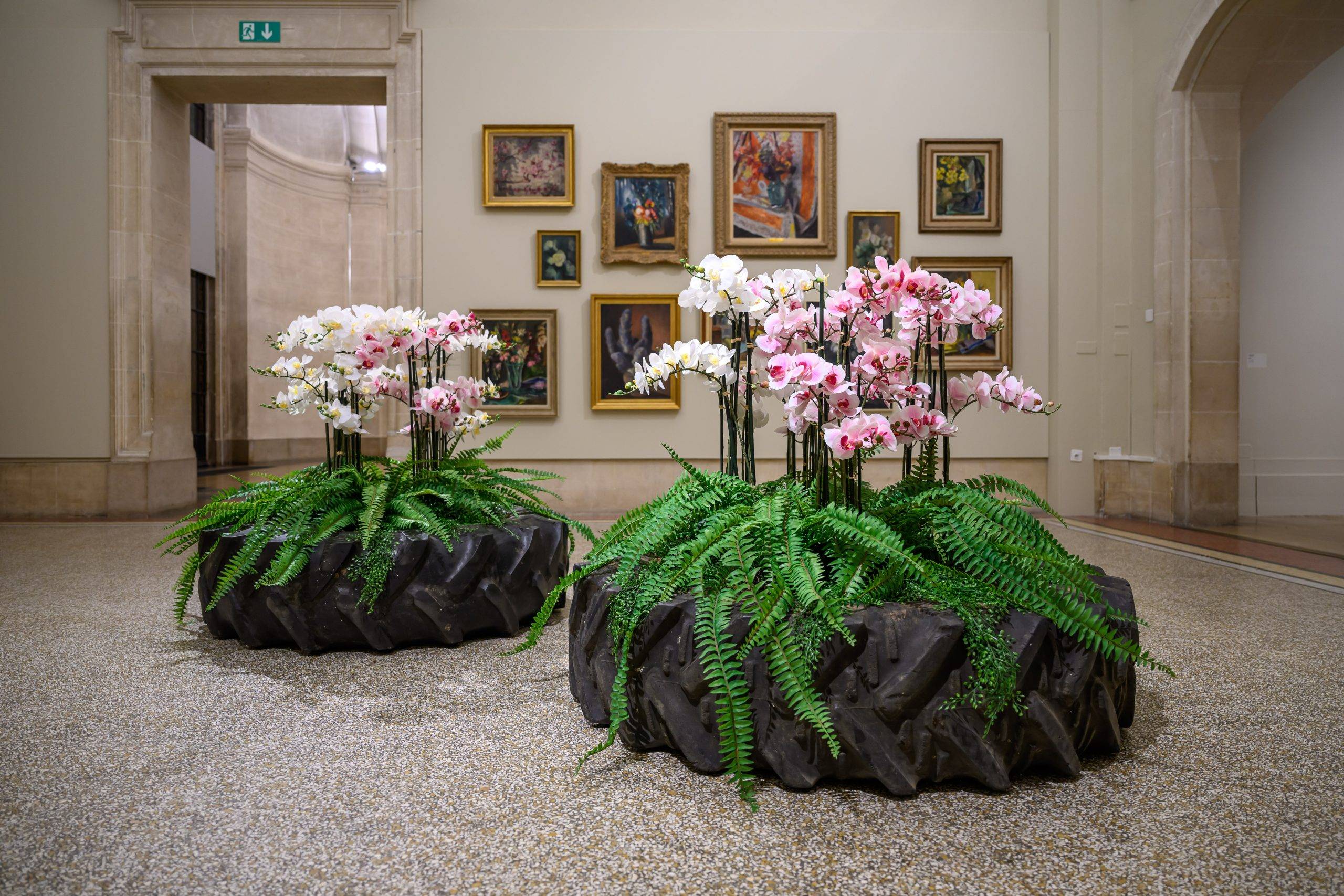
In museums, when we look at an artwork, we generally form our own interpretation, but then again, there is never a definitive explanation because opinions can always be discussed with others. This is something I have always enjoyed, and it also applies to musical instruments. For example, there are two pieces featuring guitars here. If someone is looking at this piece next to you, they might say, “Hey, the guitars are the same color as the painting right next to them.” “ Another might say, ”Ah, I know the musician who used that guitar,” and be more interested in the fact that it is represented again. Yet someone else might focus on the shape of the instrument… In a way, each experience has the meaning you need at the very moment you engage with it.
This is not the first time you work with Marc-Olivier Wahler. You already collaborated on a project at the Swiss Institute in New York, then at the Palais de Tokyo in Paris. What makes this exhibition so linked to the city of Geneva?
John M. Armleder:
This isn’t something most locals know, but back in the 17th century, the city was attacked by its neighbours, the Savoyards, who were mostly mercenaries hired to do the dirty work. When Genevans repelled the invasion, they beheaded some of the attackers and displayed their heads on stakes around the city… We certainly live in violent times, but we have known quite some dark periods. Once again, this should serve as a lesson. I have been a committed pacifist from a very young age and refused to undertake military service, which was compulsory at the time and resulted in a seven-month prison sentence… I was detained in a facility in this neighbourhood, so it brings back a lot of memories… Despite everything, I genuinely enjoyed working in the Armoury. Some weapons from that era are still intact and reflective, so I wanted to make them dialogue with shimmering films and drapes of metallic fabric. An interplay of concealment and revelation lies at the heart of the project. It was important for me to arrange the space in such a way as not to glorify weapons, but to contextualise their presence and reveal how they function.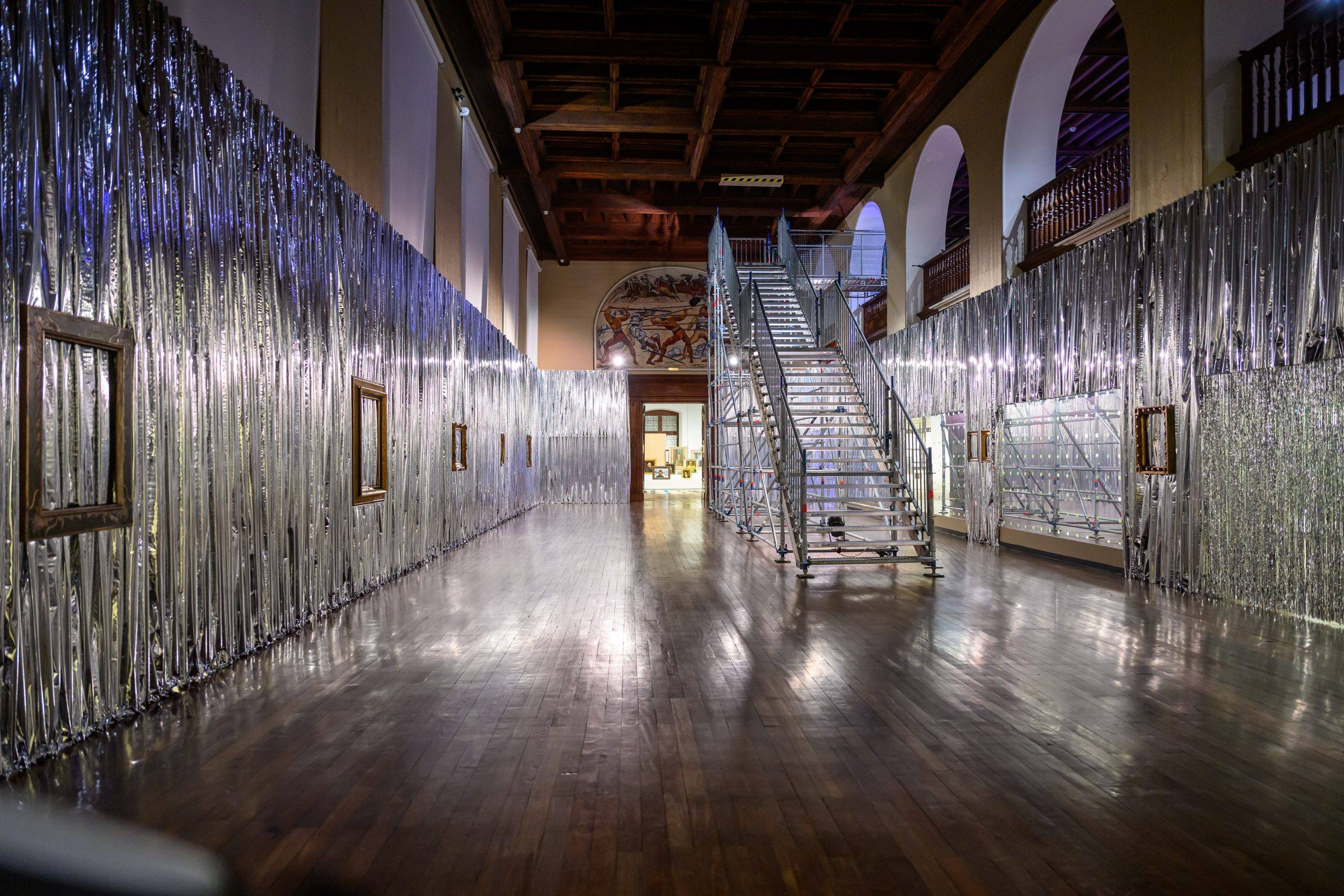
You also displayed a collection of frames… What is their significance within the context of art history?
John M. Armleder:
Sometimes, frames are more valuable than what they contain. This is often the case in museums. Here, when you look at the frames, you may see your own reflection, as they are made from mirrored sheets. I have always been drawn to the idea of turning the frame into the artwork itself, leaving it empty or allowing it to reflect the viewer’s image. In 2009, I took part in the exhibition Vides at the Centre Pompidou, which explored this concept through the work of artists such as Gustav Metzger, Robert Barry and others. It all began with Yves Klein’s exhibition at Iris Clert in 1958, which was arguably the first major exhibition in which nothing was on display. He did cheat a little, however, by serving blue champagne at the opening… It was a bold move on Laurent Le Bon’s part, who conceived the idea, as half of the Pompidou Centre was filled with empty spaces.
Personally, I find the idea of exhibiting nothing (or showing everything) particularly compelling, and I see this paradox as fundamental. By this logic, everything ultimately becomes equal to nothing, and I believe this raises an important political point. We must remain aware that memory fades, and that it is our responsibility to revive it, so as not to repeat the disasters to which we have contributed, in one way or another, through our silence. An exhibition like this, I think, brings that issue into focus. We have a responsibility, as individuals, and especially as artists, exhibition curators or museum professionals, to call attention to what may happen if we fail to confront it.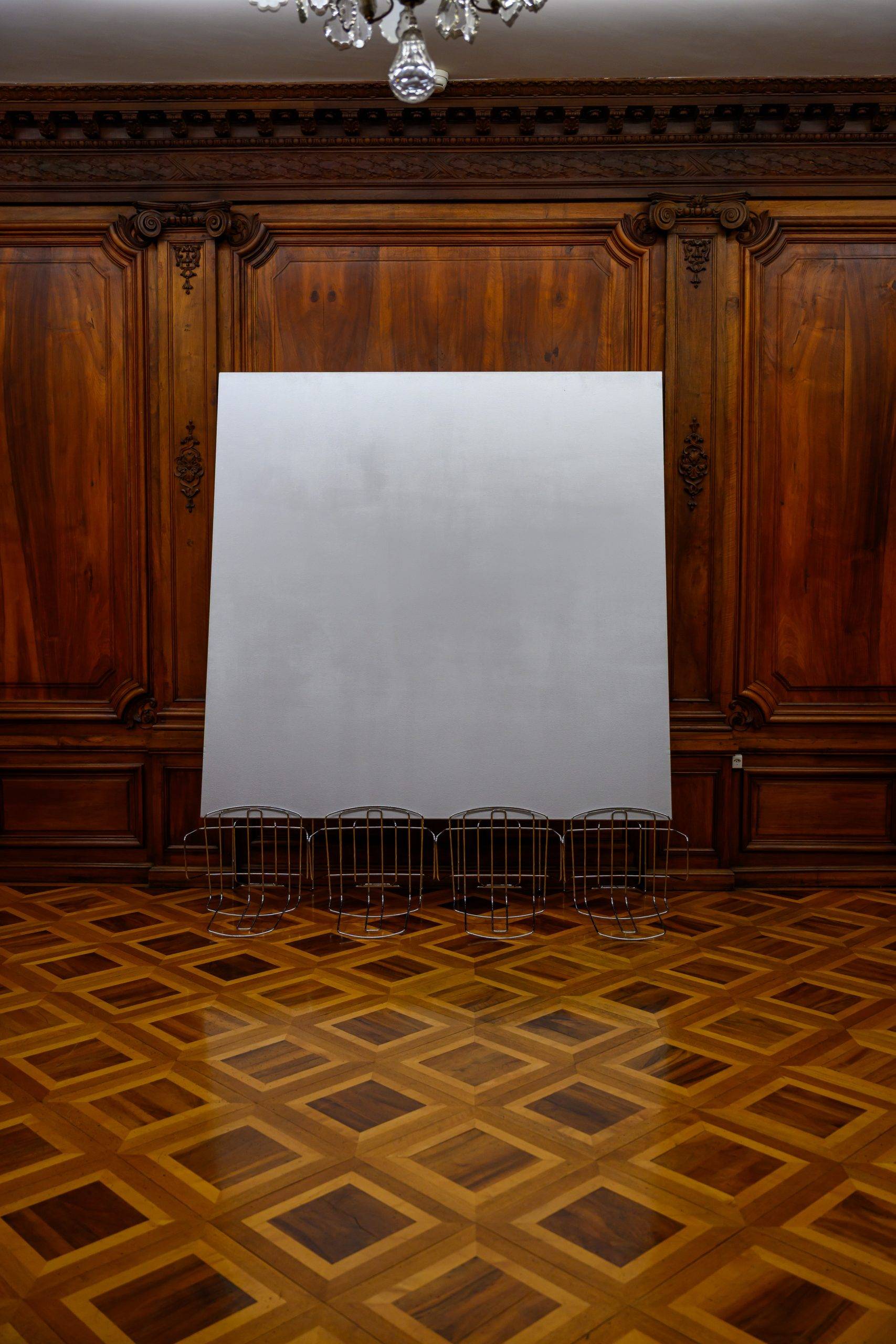
“Observatoires” seems to be quite a personal exhibition…
John M. Armleder:
Yes and no… I very much enjoyed preparing it, but at the same time, to paraphrase Marcel Duchamp, I want the viewer to be, to a large extent, the author and creator of their own project. That is the underlying principle of my exhibitions in general…
Observatoires, Geneva Museum of Art and History, from January 25th to October 25th.
Interview by Marie Maertens
Photos: Michaël Huard


