


MILLE
Instinct comes first, but awareness arrives through the eyes of others
“Music is a vast container, made not only of words and melodies. There’s the body, too. When someone sings, they sing with their whole body”
Some people write songs the way they tailor clothes: made to measure, with a love for detail, but unafraid to cut where needed. And then there are those, like MILLE, who do both: she sings, sews, acts, lives. The stage name of Elisa Pucci, a Roman artist, musician-turned-actress, she’s one of those voices that surprise you with how they slip into the folds of the Italian language and linger like the scent of theater and cotton candy. An artist who chose to sign her name with a number, as if to suggest that defining her in just one way is impossible. After fronting the band Moseek — finalists on X Factor in 2015 — Elisa decided to go solo. And so, MILLE was born: a project that breaks free from all labels — musical, discographic, existential — to give voice to her many selves. She writes in Italian, but her approach is anything but traditional: it’s playful, sharp, honest, and sensual. And when she sings — a mix of biting irony and retro longing — she always seems to be halfway between a stage and a late-night heart-to-heart. In 2023, she released her first EP, Quanti me ne dai, and hasn’t stopped since: over 70 live shows, awards, prestigious opening acts (Max Gazzé, Carmen Consoli), culminating in her performance at the Concerto del Primo Maggio in Rome’s Circus Maximus. Now she’s back with a new album on the way (Risorgimento, out mid-September) and two singles that already set the tone: Il tempo, le febbri, la sete and C’est fantastique. We met her at Milan’s Urban Hive Hotel, just off Corso Garibaldi, a few days before her summer tour kicks off — from the city’s Arco della Pace for the Pride event on June 28, down to the South of Italy, with a stop in Avignon, France (on July 19) while in autumn also some dates in clubs: November 11 in Milan (Santeria Toscana) and November 12 in Rome (Monk). Somewhere between a joke and a dizzy spell, she told us who she really is — the girl of a thousand faces.
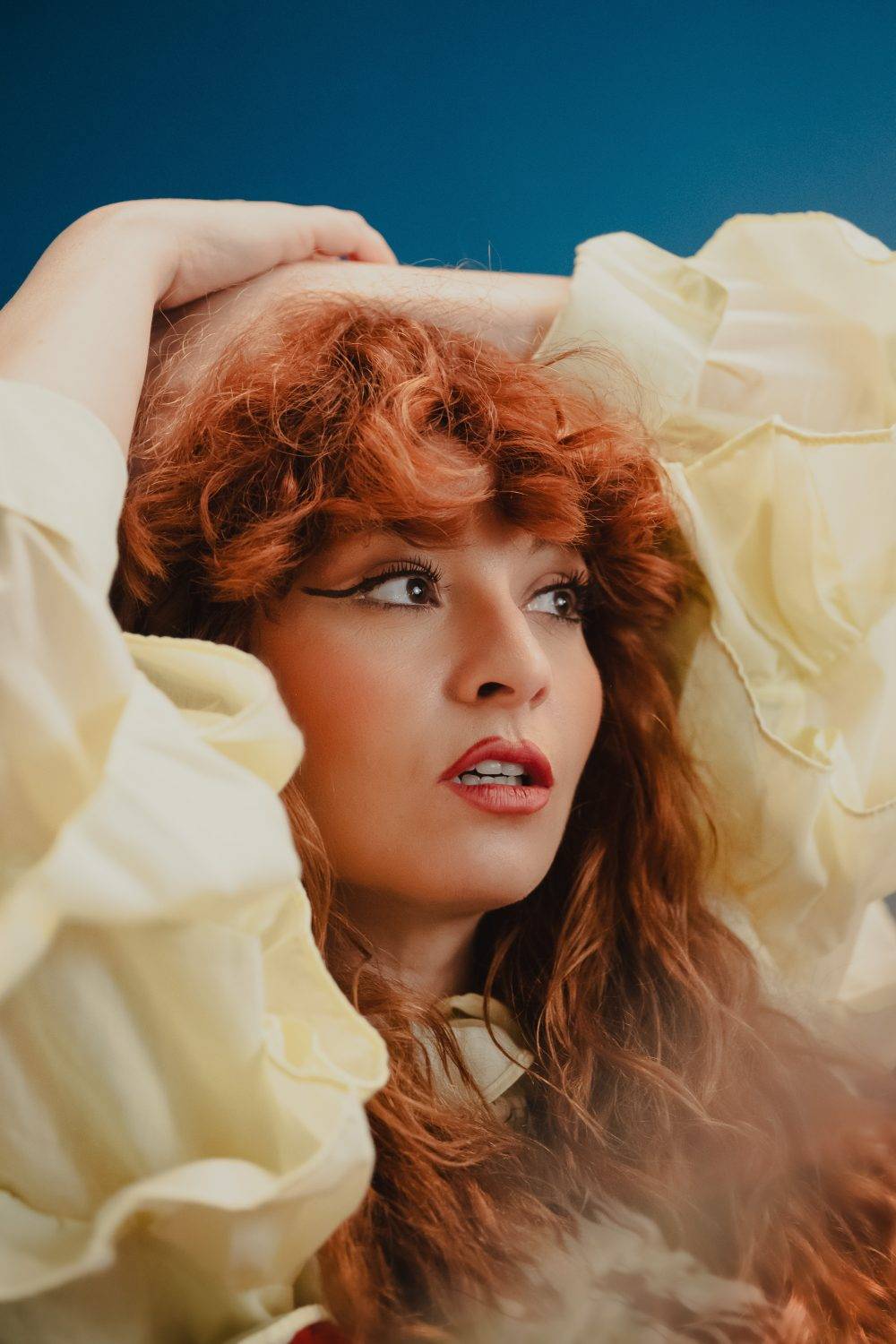
Why did you choose to name your first album “Risorgimento”?
I feel deeply connected to that word, for several reasons. First of all, etymologically, it means “to come back to life” — and in a particular historical moment, both collective and personal, it felt like the right word. Also as a form of self-help: returning to the source, to movement. Then there’s the reference to the Risorgimento uprisings — a historical period that has fascinated me since I studied it in elementary school. The Risorgimento is a movement from the past that you don’t disown, but keep in mind, to stay present and in motion, with your gaze turned toward the future. For me, that’s a necessary condition to face things. I’m also drawn to the aesthetic of that era: the frames, the graphics, the symbols — elements I tried to echo in the artwork for my singles. And then there’s Garibaldi… My name is MILLE, and I like connecting the dots life places in front of me. I didn’t choose Risorgimento as a title in a calculated way — it was more of a realization. Garibaldi, after all, was a pop star — maybe the first Italian one: when he arrived in London, 500,000 people came to greet him! And my dad has always called me “Garibaldi” because of the way I am. Everything just came together naturally..
Your songs feel like scenes from a movie — little sung short films. How do you build the connection between words, images, and sound? Do you start from an image, a line, an emotion…?
Usually, the lines already come to me with music in my head. I often write without an instrument in front of me. Then, when I’ve gathered enough ideas, I sit at the guitar or piano and give them form. But they’re born already tied together — lyrics and melody at once, maybe quickly recorded on my phone. I try to pin them down, to mentally freeze them. It’s as if the songs come to visit me, and I just have to welcome them.
Listeners often say there’s something timeless in your voice, like it’s coming from an old car radio. How much of that retro — yet never nostalgic — style is intentional, and how much is instinctive?
It’s all of it. That’s just how I am — I couldn’t be any other way. Instinct comes first, but awareness follows through the eyes of others. When several people point out the same thing, it becomes real. But everything starts from a kind of urgency, from something that naturally belongs to me. It’s not a constructed style — it’s simply who I am.
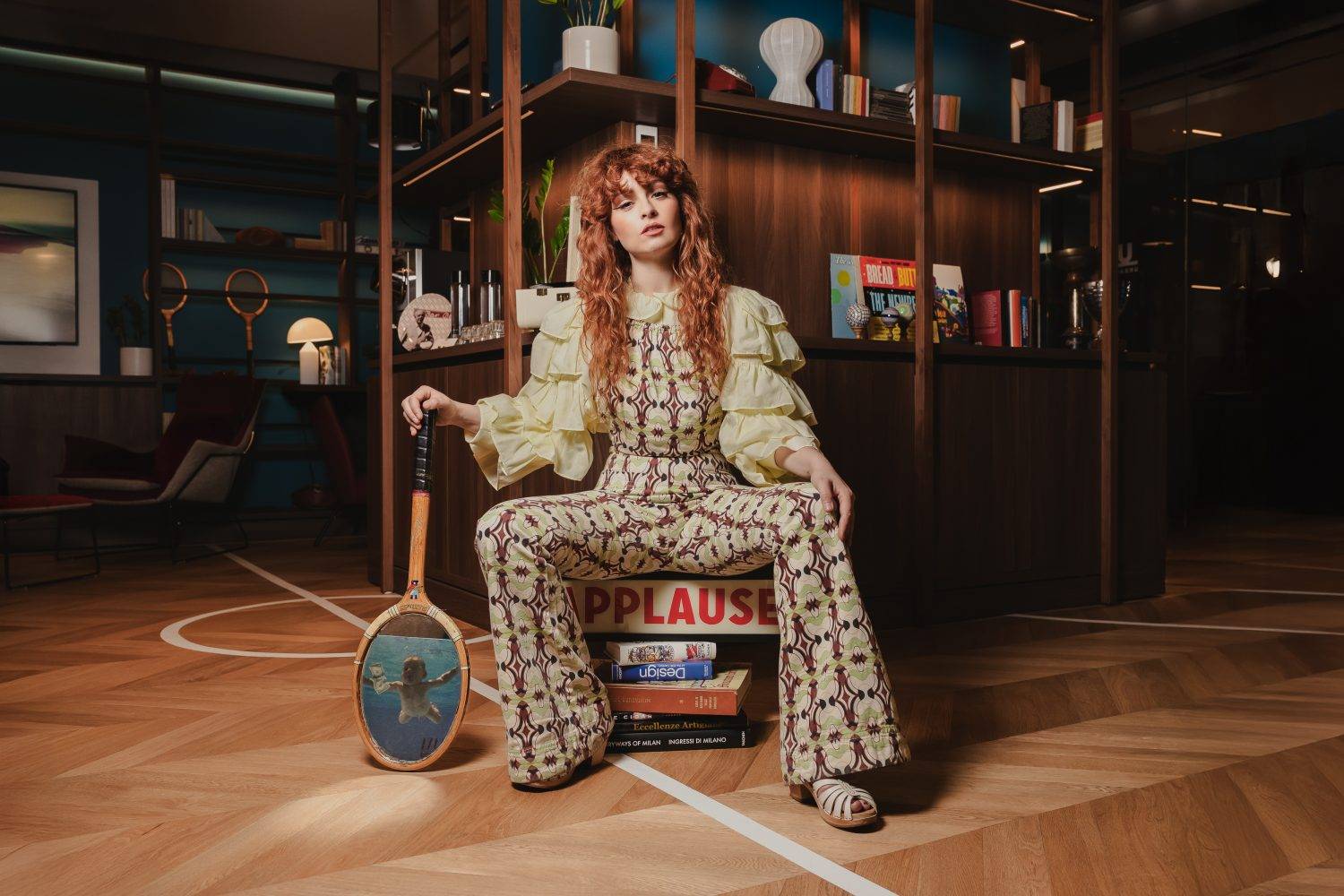
How important is visual aesthetics in your musical storytelling?
Hugely important. Music is an incredibly vast container — it’s not just made of words and melodies. There’s also the body, the visual element. When someone sings, they sing with their whole body, not just their voice. When you go to a concert, you don’t say “I’m going to hear” an artist — you say “I’m going to see” them. And I’m deeply drawn to everything that can be touched and seen. When I write, I completely immerse myself in what I’m creating. I see the scene, I touch it. Aesthetics, for me, are an essential part of musical storytelling.
You also have a background in acting, starting from X Factor. How much of that experience do you carry with you? And what have you left behind?
X Factor was an incredible and really fun experience. We had the chance to bring to life any idea we could think of. Like: “Imagine singing on a giant scale.” And they would actually build it! As for theater — it’s not just a past for me, it’s also a present. I’m currently performing in a reimagined version of La Locandiera, and I’m loving it. I don’t think I’ve really let go of anything: I evolve, I refine, but I don’t abandon. Experiences pile up, and everything I do today is also the result of everything I’ve done before.
So not just an acting past, but also a present…
Exactly! I started last year with La Locandiera, though I’d done some small projects after university as well. Now we’re on tour — we’ve performed in Switzerland, Milan, Bergamo, Brescia… and I hope we’ll manage to fit in more dates. It’s not always easy, but we’re trying.
You’ve described yourself as “a sum of small catastrophes and big revolutions.” Is there a revolution — big or small — that Risorgimento has already sparked in you?
Well, if I had to be precise and look at the timeline of events, I’d say that in January I completely overhauled my life. Everything changed — professionally, emotionally, even my home. So yeah, 2025 has definitely been a full-on Risorgimento in every sense, and in a very short span of time. The songs on the album are all snapshots of this moment: I wrote them between September — when this whole process of evolution, and yes, revolution, began — and February. That’s what it was.
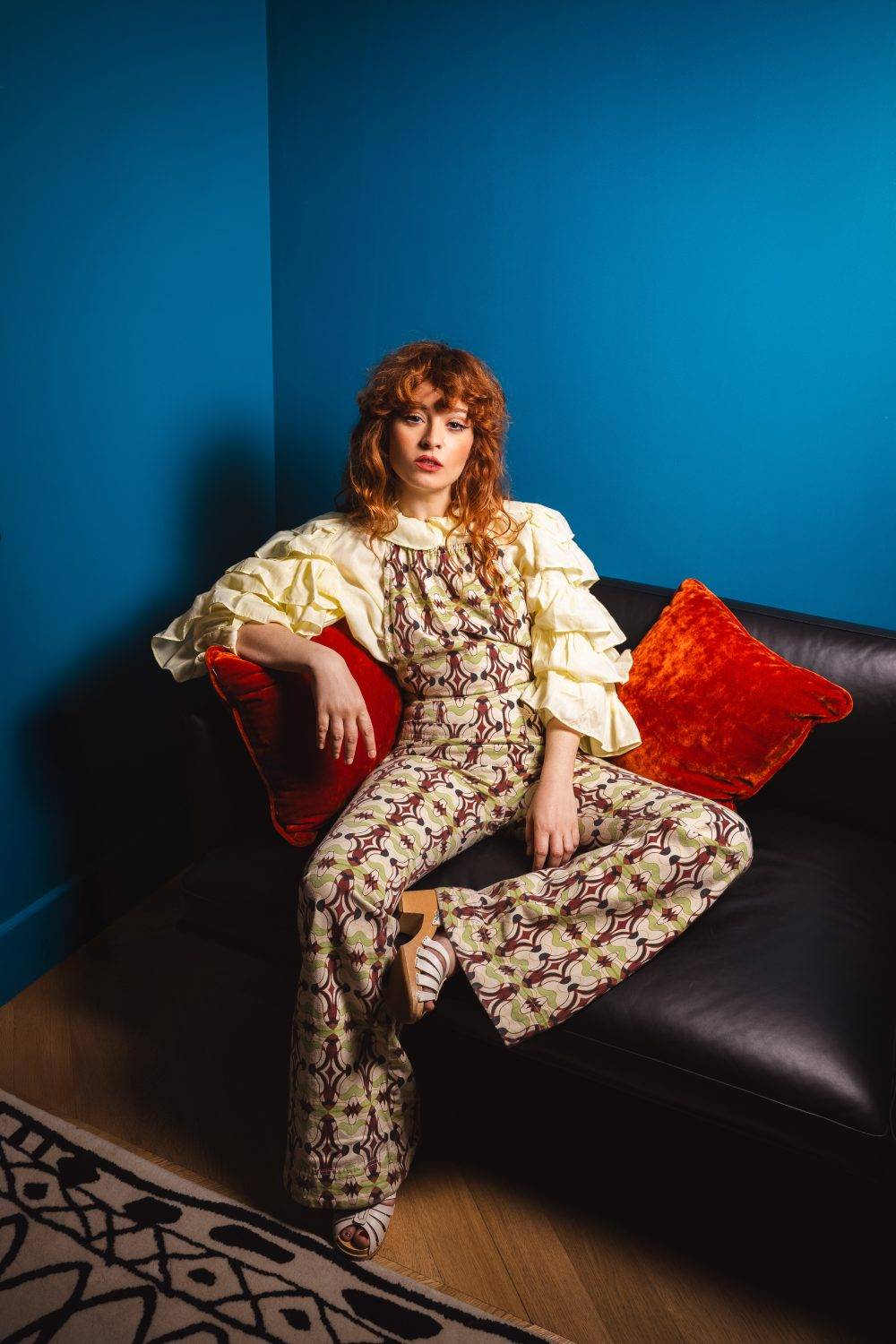
Who are your muses?
There are many. Often, they’re people who do more than just art. The first one, unknowingly, is my mother. As a style icon, probably — also because I resemble her a lot. We have the same long hair, the same slightly melancholic air, very Mina. She taught me how to sing… not technically, because she has nothing to do with the world of music, but in the way she used to sing alone, leaning out the window after lunch, smoking a cigarette and humming Gino Paoli. That way of hers has stayed with me — to me, it’s still the right way to deliver words in a song.
Then there’s Raffaella Carrà — for her persona, her message, her energy. And Patty Pravo. And Caterina Caselli. And then there’s Vali Myers. She was a would-be dancer, a kind of “stray” artist — let’s put it that way — who lived across the first and second half of the 20th century. Without support from her family, she started dancing in cafés in Paris, then in Germany, then in Italy. She eventually settled in Positano, where everyone called her “the good witch.” She had a striking aesthetic: red hair, intense eyes, almost tribal makeup, and she created these incredible, almost magical drawings. At first all black and white, and later in color — after she too went through a transformation. I’m fascinated by her whole world. This love affair with another tormented artist, these crooked lives we can’t help but love. She inspires me. Just like Vivienne Westwood. And of course Frida Kahlo — I even have her tattooed. With Diego Rivera, their whole story. These women — and yes, they’re all women — are always with me.
If you had to introduce MILLE to someone who’s never listened to your music with just one song — from your new album or older work — which one would you choose?
A track that hasn’t come out yet. A song I haven’t released… it’s called “Posologia”.
Your songs pay a lot of attention to language, detail, and almost cinematic silences. How long do you spend writing, and how do you know when a track is truly finished?
Generally, when I’m writing, I’d like the process to be over as quickly as possible. Because then comes the whole phase of arranging, producing, mixing… and honestly, that bores me to death. I know a song is finished when I can sing it from beginning to end and feel satisfied. But now there’s a bigger sense of responsibility, because this is also my first album. I’m lucky to have outside perspectives too, not just my own or that of my partner Davide Malvi — stage name Unberto Primo — with whom I write, produce, and so on and so forth.
The greatest film of all time?
“Gone with the Wind”.
Which actor were you crushing on in high school?
Joshua Jackson from Dawson’s Creek. But come on, who wasn’t?
In hell, they play the same song on loop. Which one?
“Obsesión” by Aventura.
If you hadn’t become an artist…
I would’ve worked in graphic design. Or become a psychotherapist. Or both. Or I’d have become a wanderer. A homeless person. A clochard…
Portraits: Ludovica Arcero
Interview: Germano D’Acquisto
Special Thanks to Urban Hive Hotel Milano


