


Guillaume Marbeck
From shadow to light
“Cinema is about making the invisible visible in order to generate a truth.”
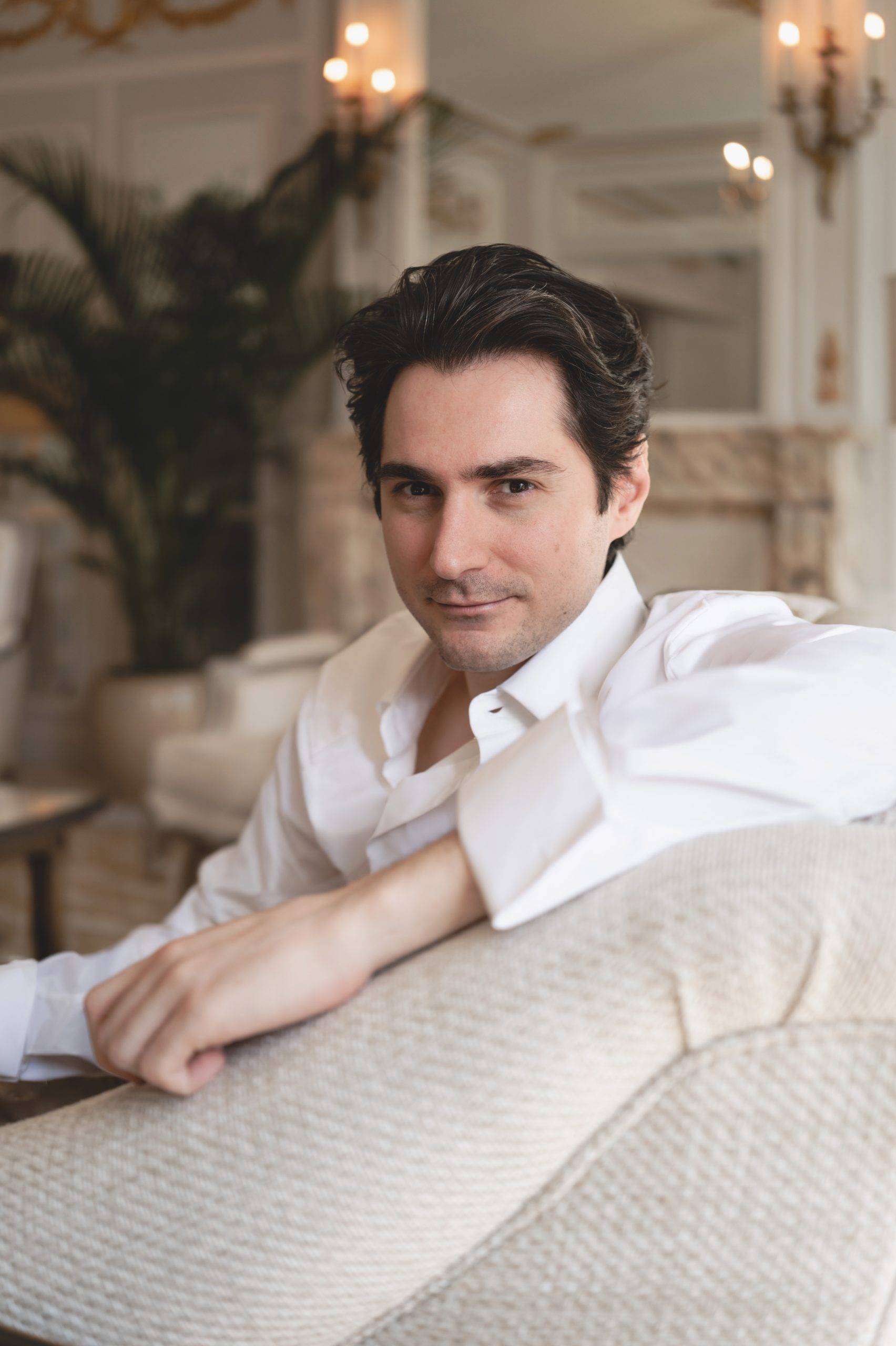
At a time when many of his greatest role models have passed away, he embodies a new face of French cinema. In the context of his nomination for Best Male Revelation at the Nuit des César Ceremony for his role of Jean-Luc Godard in Richard Linklater’s Nouvelle Vague, and after attending a string of prestigious ceremonies since the Cannes Film Festival, Guillaume Marbeck shares with us, with an enthusiastic freshness tempered by clear-sightedness, his experience of stepping from the shadows to the light. He shares his sincere, committed, and inclusive vision as a craftsman of the industry, a vision built step by step, after exploring every facet of the industry, from technician to the main face of a film. Behind his “French-style” poetic depth, his “Italian-style” elegance and his “American-style” withering attitude, which we all discovered in the heart of the Plaza Athénée, he reveals a stable and grounded personality, positioning himself beyond its art, as an avowed spokesperson for the invisible professions of cinema, those without which it could not be perpetuated, or even reinvented.
Having gone from being a nobody to starring in a film cherished by major festivals and award ceremonies since Nouvelle Vague, many compare you to a lottery winner. But you didn’t come from nowhere; you graduated from film school and completed two years of acting training. Haven’t you ever felt a deep conviction that such an opportunity would eventually present itself?
Guillaume Marbeck:
I always felt like I’d be scouted on the street. I was scanning people on the subway, wondering if they were in the film industry. After 2020, I realized that things had changed, that the world had become dematerialized, and that street casting had moved to the Internet. So I decided to make myself omnipresent online by posting as many photos and videos as possible on websites featuring actors.
I’m thinking back on your YouTube video that led to your involvement with the Nouvelle Vague team. Why do you think it caught Richard Linklater’s attention?
Guillaume Marbeck:
None of this would have happened if Stéphane Batut, the casting director, hadn’t first noticed me through my presentation video. I made it as honestly as possible, reflecting my individuality… as if I were offering myself up to the role of Guillaume Marbeck in my own biopic. Every actor is unique, but more often than not, and I’ve experienced this, actors tend to express only a tiny fraction of themselves, what’s expected of them, as if they were focusing on a single ray of color in their rainbow. I prefer to offer a wide range of my abilities and give people something to think about: what we could develop together.
The tone of your video is free and spontaneous, probably in line with Godard’s personality at the time of Breathless. Just like in New Wave, the technical aspect is perfectly mastered: it must come from your previous life, where your main job was to be a photographer.
Guillaume Marbeck:
It was my desire to convey my spirit of freedom. To achieve this, I positioned the camera, adjusted the framing four times, and increased the lighting. I shaved to make it look better, and I chose my outfit. The staging was very controlled. Once I was reassured by the result, my performance felt liberated. Do you have to be a photographer to become an actor? I don’t know. But the profession is constantly demanding more self-tapes and videos for casting auditions. There are a million ways to film yourself, but only one to truly capture the desired character. This creates a huge imbalance for actors who aren’t photographers.
Freedom of action versus meticulous preparation: is that what differentiates the production of Breathless from that of Nouvelle Vague?
Guillaume Marbeck:
The filming conditions of Breathless have been the source of many myths and legends, such as the idea that there was no script, that it was created day by day. This is not how it happened at all. Godard worked from a notebook in which he had written all his ideas over the past ten years. He would insert them at appropriate moments throughout the film. Ultimately, it was improvisation, but not without a genuine outline. In Richard Linklater’s case, it was necessary to recreate an entire era, which required considerable preparation time. Paradoxically, the rigor imposed by the Nouvelle Vague production offered a certain kind of freedom. Memorizing the text and scenes gave us the necessary foundation to allow for improvisation, by changing the rhythm of a sentence, the movement of a body within the frame.
As mentioned in the film, you have something in common with Godard in that you both started your careers later in life. Doesn’t your freedom of approach stem from the time you devoted to knowing yourself, to accepting yourself, before you started out?
Guillaume Marbeck:
Before becoming an actor, I aspired to be a film director. That’s why I wanted to immerse myself in all aspects of the film industry. I started as a prop assistant on the film Serial (Bad) Weddings, a strategic position that allows you to interact with 95% of the crew on a filming set, because everyone needs a lighter or a piece of tape. Then, I tackled framing as a camera assistant on No Limit, a police series starring Vincent Elbaz. At other levels of the industry, I explored marketing through distribution. I also honed my critical eye through the buying initiatives of the Cannes Film Market (the context of our meeting in Cannes), which required me to watch 10 to 15 films a day. With all these experiences, I was able to understand the inner workings of the profession, and see to what extent one can delegate to others with complete confidence.
This professional journey illustrates a valuable life lesson for younger generations.
Guillaume Marbeck:
The main issue lies in the barriers to entry. These days, anyone can pick up a camera and take pictures. Unfortunately, or perhaps fortunately, not everyone can take a beautiful photo because it requires experience, taste, learning the techniques, and directing actors. So much so that you have to face failures to achieve a result, along with miraculous solutions that you can only discover by doing things yourself.
You have a decidedly rationalizing and artisanal approach to the profession.
Guillaume Marbeck:
I even worked in “production value,” a mission focused on optimizing a production’s output without spending a single extra penny. For me, it’s a shame not to give your all, regardless of the resources available. Sometimes, with big-budget films, you wonder where the money went, while a modest production can produce spectacular results. In reality, the question is less about the resources and more about the level of excellence of the person behind the film, or the scope of the idea. In 1959, Breathless was an attempt to redefine filmmaking: producing differently, with fewer resources but more freedom. I identify with its artisanal approach: understanding the rules and legacy of a craft to unleash one’s inventiveness. Godard challenged his cinematographer at the time by wanting to shoot at night without lighting. Only photographic film had the necessary sensitivity, but in small rolls, not long enough to shoot scenes in a movie. Raoul Coutard had to splice them together. It was truly a craftsman’s work.
Is playing a role as symbolically overwhelming as Godard confining, or a lever to other roles?
Guillaume Marbeck:
I don’t think it’s confining at all. You have to start somewhere, and you couldn’t hope for a better entry point into the profession. Especially since I’m barely recognizable behind my dark glasses and my receding hairline. Generally speaking, a biopic of an artistic figure offers a much wider range of emotions than a fictional character. Moreover, Richard Linklater wanted to demystify the role by only casting unknown actors, so that when you see the film, you no longer question whether the actor is portraying Godard well or poorly.
To embody such a personality, where is the line drawn between imitation and “the art of interpretation”?
Guillaume Marbeck:
My goal wasn’t to imitate Godard, to create a caricature that generates a smile, but rather to make people truly wonder who this man was, where he was going, what his madness was! My interpretation sought to capture the essence of his temperament, something indefinable that is expressed in a look, a voice, a presence. Because ultimately, cinema is about making the invisible visible in order to generate a truth.
In other words, you have to be “more real than life.” This role has certainly revealed the charismatic dimension of your personality.
Guillaume Marbeck:
Playing a “rebel” aligns with my cinematic tastes and my perpetual questioning of rules, which also likely stems from my background as a skater. Yet, in real life, I don’t consider myself particularly charismatic. I don’t want to cause a stir or make a scene, except in a very private setting, or somewhere I don’t know anyone. But in a film, if I’m given free rein to smash things, I almost ask if the person is sure of themselves, because things can get very extreme.
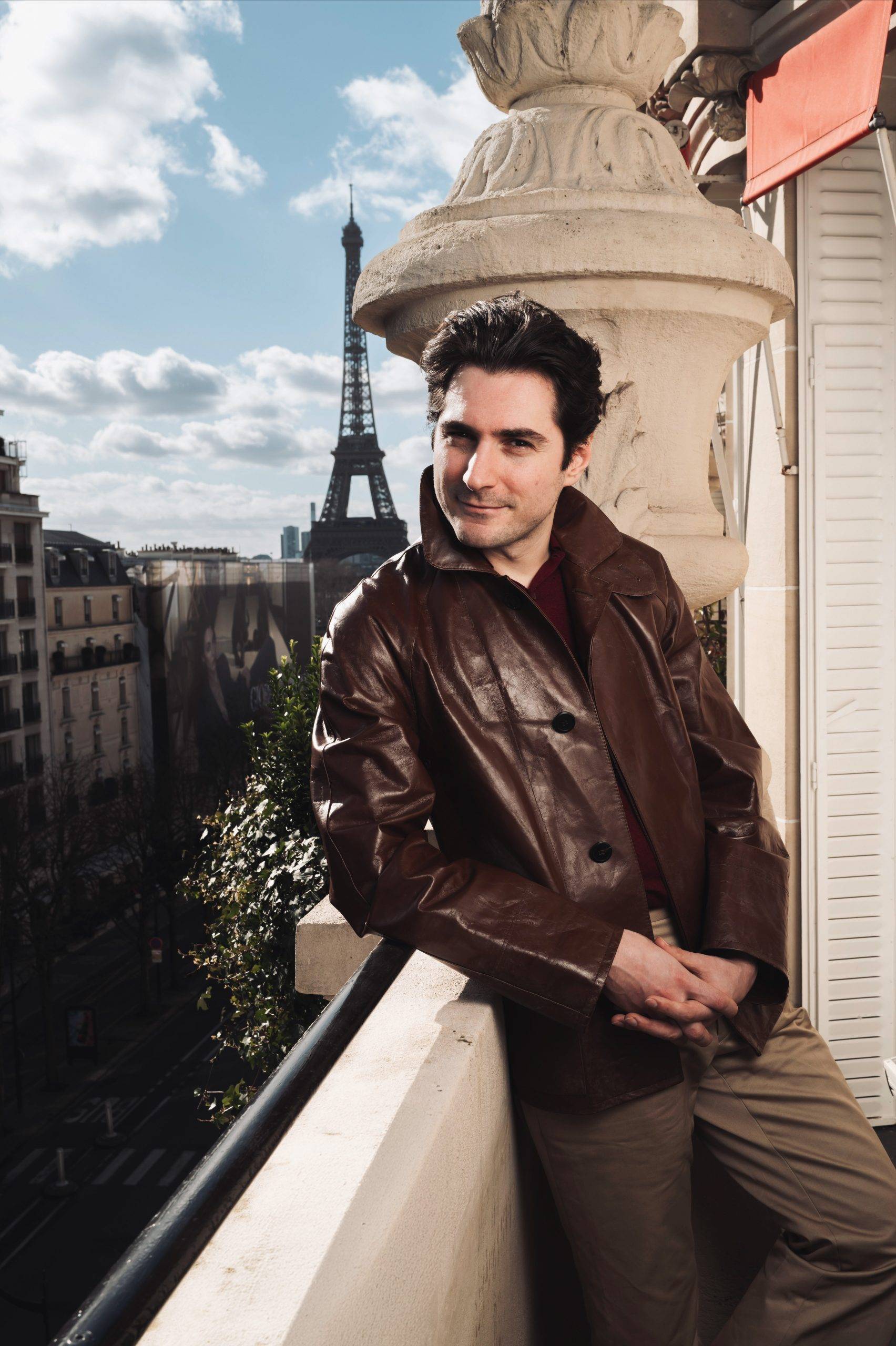
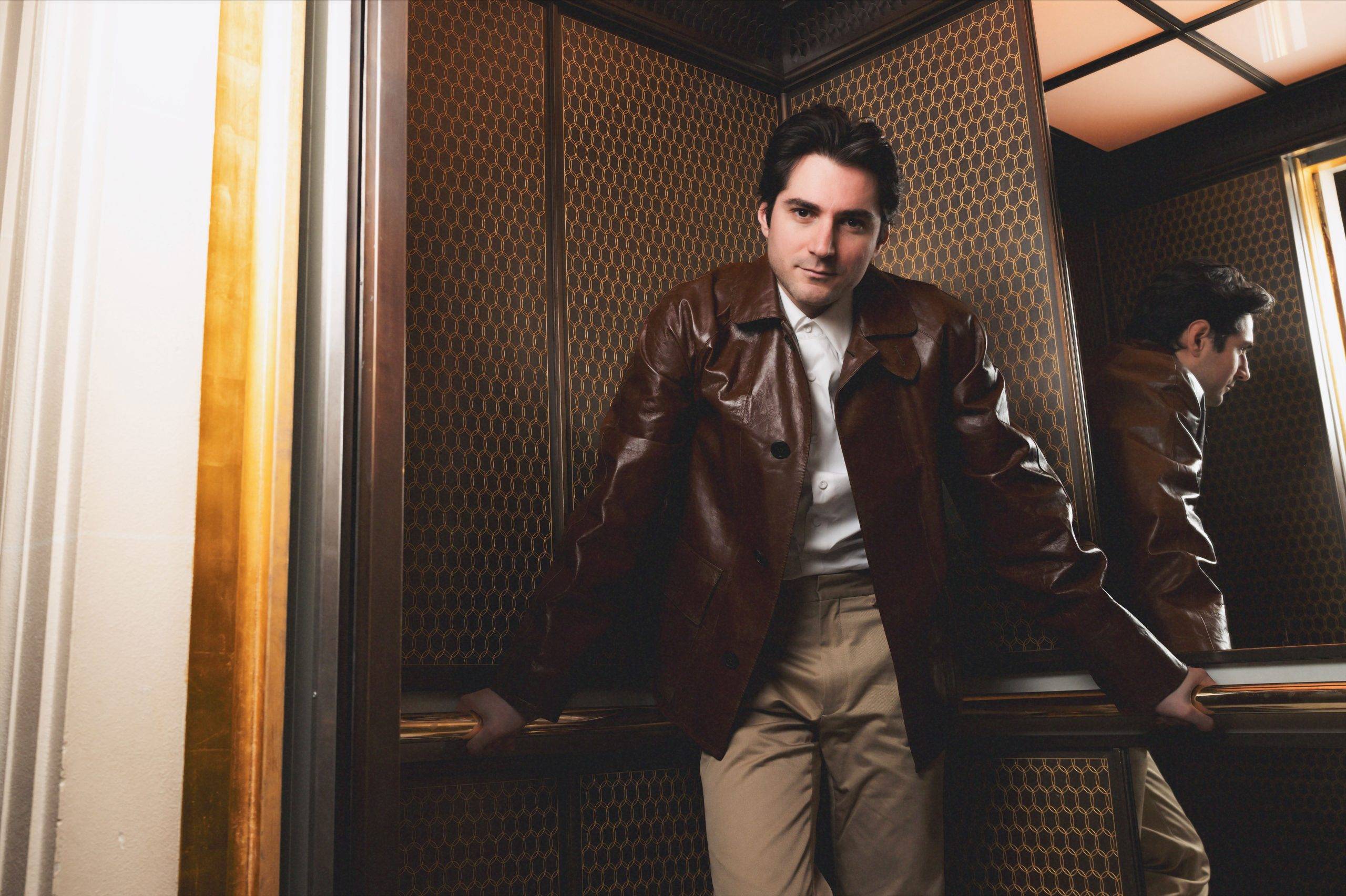
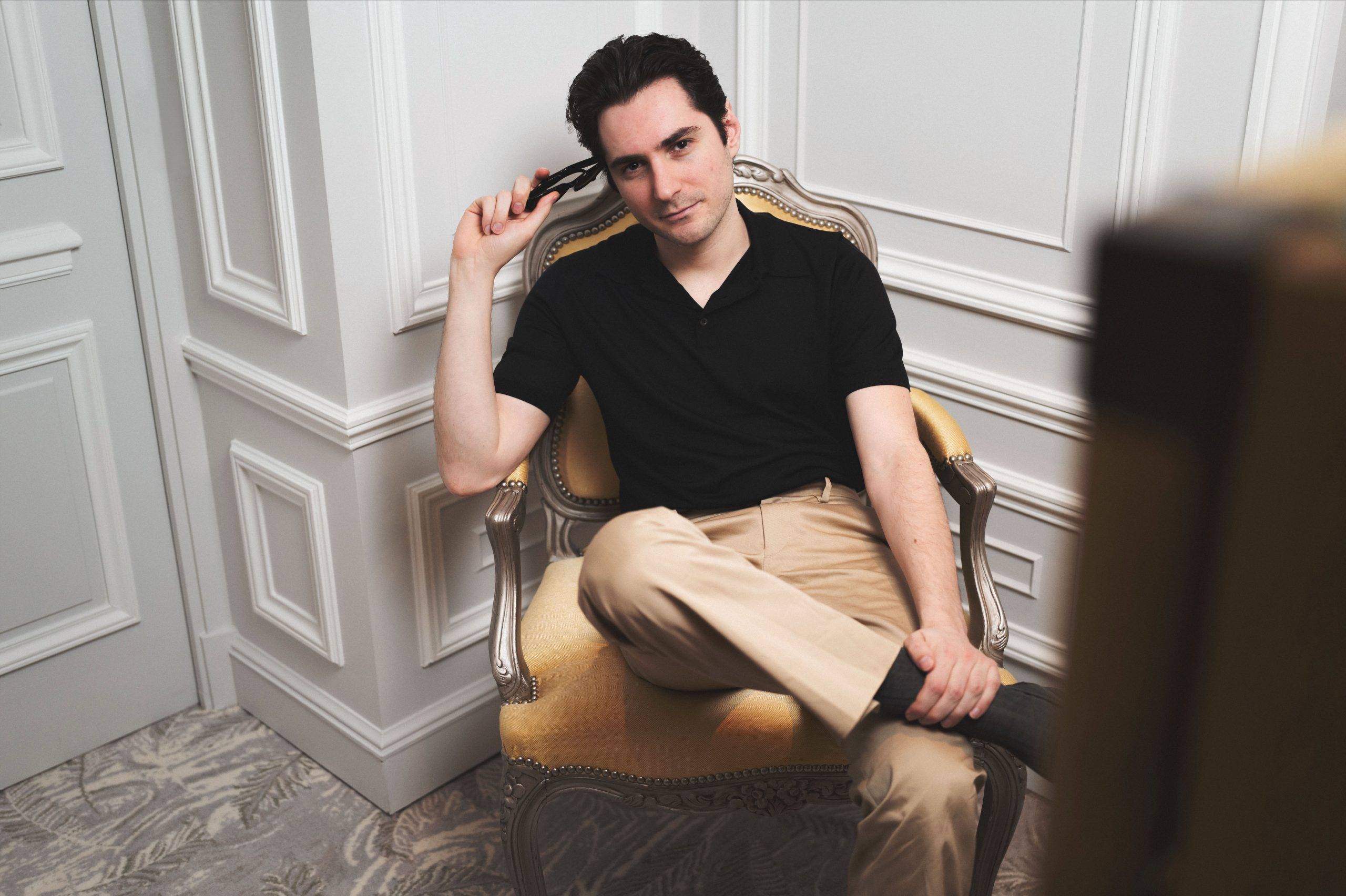
This irreverent yet smart tone could be described as “American style,” which heavily influenced the French New Wave at the time, and which may explain why it’s an American director who has chosen to embrace such a movement today. Moreover, during the preparation for this Say Who photoshoot, we enjoyed drawing inspiration from the attitudes of a young Robert De Niro, as well as from the wardrobe of a fashion house like Prada, which combines Italian elegance with the iconic spirit of American cinema, to create this image of you, and to see how easily you slipped into this new persona.
Guillaume Marbeck:
There’s the stylized approach of Martin Scorsese, the more pictorial style of Brian De Palma, or the more minimalist style of Ken Loach. I find myself drawn to all three aesthetics because they all convey an energy, a vibrancy, with the feeling that in the next frame of a film, a surprise is potentially about to happen, like a lion ready to pounce. And then they all share this quest for depth that makes them authentic. I don’t know to what extent we’ve reached that depth today, but like a film crew, we’ve collectively constructed our intention to get there, to find the right tone.
Are you currently discovering other facets of the acting profession, such as the promotional work surrounding the film’s release, which can be just as demanding as the creative phase?
Guillaume Marbeck:
With my experience in distribution, I’m fully aware of the challenges involved in building a film’s reputation with the public. However, I’d never experienced this step from the inside. Since then, I’ve developed immense respect for every actor involved in promotion, both in their own country and in those where the film will be distributed. You’re constantly faced with the same questions, all while trying to keep your answers fresh. At first, it creates a kind of unsettling vulnerability because of the feeling of not being understood. And over time, you refine your pitch, almost like a stand-up routine.
How did you experience your path from nomination to nomination, from the Cannes Film Festival to the Lumière Festival, from Deauville to the Golden Globes?
Guillaume Marbeck:
With great joy. I thought to myself: now that we’re here, why not take advantage of it? When you’ve poured your heart and soul into something, it’s gratifying to realize that these people have truly grasped your vision. Knowing that the selectors, mostly operating on gut feeling, are taking real risks by believing that your film, not yet released and probably still improvable, deserves its place in the current cinematic landscape. Not to mention that these awards cement it in the collective consciousness. Spectators tend to imagine that it’s always the same names that dominate these events. But Nouvelle Vague started from scratch: an unknown cast, Linklater’s first film in French, black and white cinematography, 4:3 aspect ratio, on a legendary theme that was highly anticipated. Ultimately, finding yourself at the forefront of these events, with a single film, and the first of your career, is quite liberating.
The context that brings us together is the Nuit des César Ceremony . A festival can shine an incredible spotlight on a film and its talents without necessarily launching long-term careers. How do you see the César Awards in relation to other ceremonies?
Guillaume Marbeck:
Unlike a film festival, where the decision-making circle is limited to the personalities of a board or jury, or the Golden Globes, awarded by the press, the César Academy brings together more than 5,000 “professionals of the profession,” as Godard would say: from directors to technicians, from costume designers to screenwriters, they are all artisans of your art who bear your name. This goes beyond the isolated compliment at the end of a screening, the motivation of which—whether to cultivate a relationship with your production company or to associate your image with a newspaper—is never quite clear. Being collectively named Male Revelation by other figures in the industry whom I admire not only has a dizzying impact but also spares us from imposter syndrome.
More symbolically, are there any moments in the history of the Nuit des César Ceremony that have particularly touched you?
Guillaume Marbeck:
From my young age, I’ve been deeply moved by the slideshow of tributes at the opening of the ceremony, even more so over the last three years. It featured mentors I had met or whom I considered immortal. The feeling of emptiness caused by their passing is intertwined with a moment of passing, even a sense of movement toward the future. We are constantly reminded that we must “take our place” in life. Places aren’t stolen; they become available, naturally. It’s up to us to allow ourselves to occupy them. For too long in my life, I neglected my own plans, focusing more on helping others achieve their goals. It will be quite something to see the new slideshow, officially seated in my ceremonial chair. I’ll tell myself that one day, if all goes well, I’ll be included in one of them. It’s an unfortunate prospect, of course, but it will mean that I have been happy.
It very frequently happens that nominees leave a lasting impression on a generation even if they do not win an award.
Guillaume Marbeck:
The simple pleasure of sitting alongside all these characters is already a privilege. When you think about it, whether they’re actors, directors, producers, screenwriters, or production managers, they’re all “weirdos magicians,” regardless of their role. They’ve gone from being misunderstood kids to enchanters capable of transporting you to another world. The difficulties they faced in gaining acceptance make them even more compelling, with their inherent vulnerability and the constraints of filmmaking. They give their all, and indeed, you give your life to cinema: having free time means being available in case you’re called upon and ready to commit one hundred percent.
The question arises of what will happen after the Nuit des César Ceremony…
Guillaume Marbeck:
If only I could predict it… What is certain is that I did not return to my profession as a photographer in order to fully open myself up to new projects in cinema.
However, there is a film that is currently being released.
Guillaume Marbeck:
Yes, Alice Winocour’s Coutures. I play a rather “bitchy” makeup artist giving the reply to Ella Rumpf, and I challenged myself to portray the underhanded and passive-aggressive behaviors inherent in the fashion world, so closely linked to cinema. This role speaks as much to the pressure faced by talent as to the emotional impact on the teams that support them. I know the value of a simple “thank you,” of remembering someone’s name, and how much it draws you into a project. All these invisible gestures, like bringing you a bottle of water, taping up a cable, offering you a well-prepared meal, allow you to fully concentrate on your art and the meaning you want to convey in the story.
Do you have a role to play in defending the interests of the invisible heroes of the industry?
Guillaume Marbeck:
Yes, absolutely. When you’re in a high position, you have a responsibility: you set the tone, not just artistically, but in terms of the overall atmosphere on set. If the director is relaxed and respectful, the crew will be too. I remember, on Serial (Bad) Weddings, Christian Clavier organized a get-together and made sure everyone had a drink, even the most inconspicuous members. That gesture really struck me. So, later on, I did the same thing discreetly, to thank the crew, without saying it was my doing. I like the idea of generosity circulating quietly, like those people who work behind the scenes for you, while you’re having a blast. What struck me about Nouvelle Vague was Richard’s inclusive approach. He integrates everyone into the creative process, asks questions, and truly listens to the answers. And I think the key to success lies in freedom of expression and the exchange of ideas. For fear of conflict, debate is avoided and the result is impoverished, even though it is in the exchange and the search for common ground that truth can emerge.
We think your life is going to become outlandish with all these nominations, but you are very grounded with a calm and balanced family life.
Guillaume Marbeck:
I always wanted a stable life with a partner and children, even though I needed to fully experience my youth before settling down. A deep and fulfilling relationship made me lose my taste for adventure and partying, which I perceived as meaningless. Only cinema and art continued to inspire me outside of my personal life. In the midst of the Nouvelle Vague project, while living the cinematic experience I had dreamed of, I realized that a film, however prestigious, remains ephemeral, which made the desire for a child and a long-term project even stronger. Today, it is the stability of my personal life that allows me to commit more radically to risky roles.
Interview by David Herman
Photos: Jean Picon
Stylist: Sonia Bedere
Outfits: Prada
Acknowledgements: Plaza Athénée


