


Paula Canovas del Vas
Paula Canovas del Vas on The Art of Getting Dressed
“ We are used to being confronted with a flat image, whereas fashion is incredibly sensorial, there’s texture, colours…“
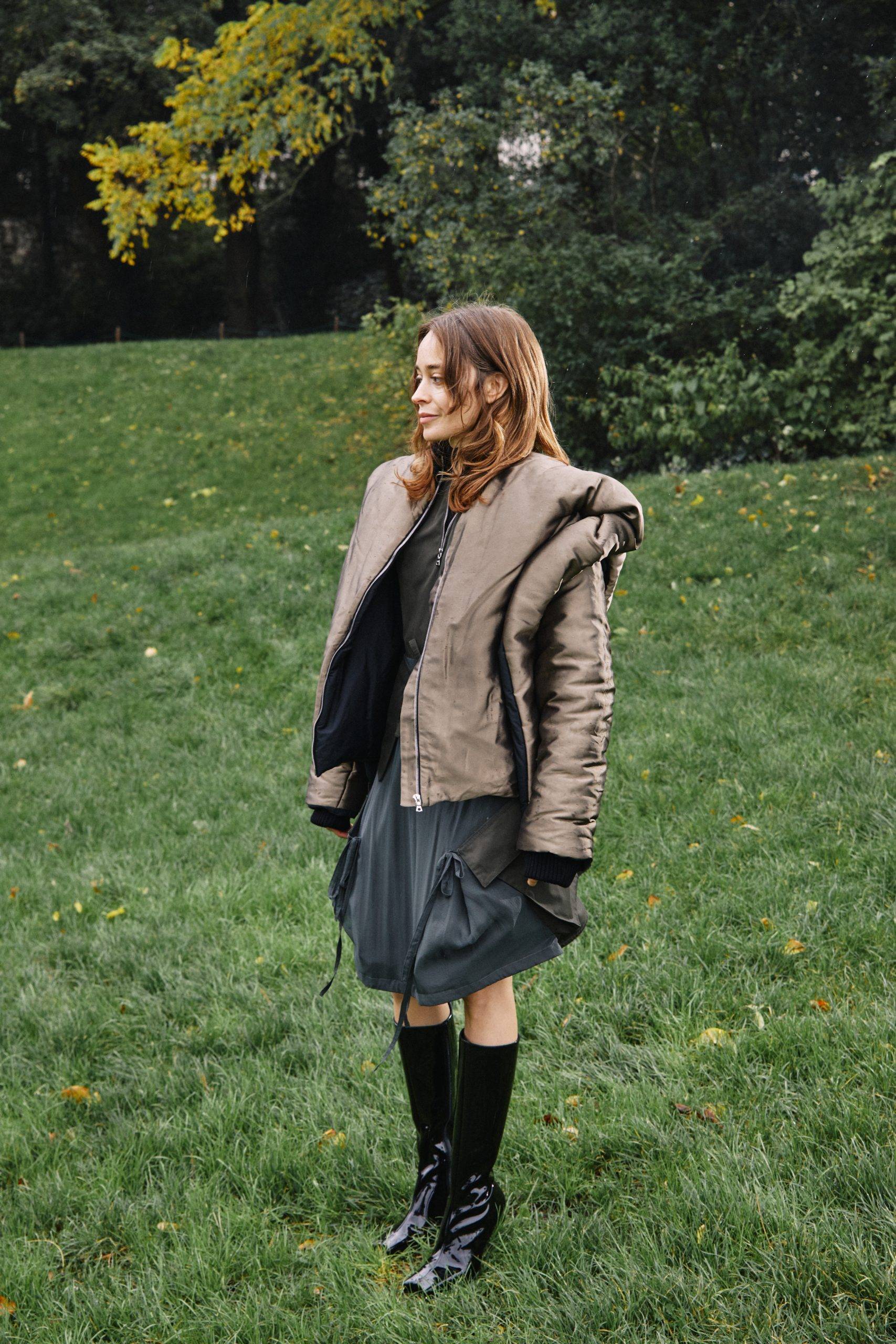
Just a stone’s throw from the Parc des Buttes-Chaumont, nestled in a cosy passage in the 19th arrondissement, a former carpentry workshop is now home to Paula Canovas del Vas’ atelier. After several years in London, where she graduated with a BA and MA in Fashion from Central Saint Martins before launching her eponymous label in 2018, the Spanish fashion designer settled in the French capital just a few months ago. Last week, she opened the doors of her atelier to us for a chat over coffee and a fun photoshoot. Fully draped in her own creations (just like she and all members of her team do daily) she gives us an insight into the Paula Canovas del Vas universe – a creative space where meticulous research meets high-quality tailoring in a vibrant palette of colours and alluring textures. We retrace the designer’s multi-layered vision, which is both a quest for fashion with depth and a return to the very essence of clothing, that is, making pieces we all want to wear.
Despite being surrounded by fashion early on in your life, it wasn’t an obvious career path for you. How did Fashion end up coming about?
I grew up in an environment where fashion was part of everyday life, my mom was a wedding dress designer, and my grandma was always making clothes. Fashion always felt very natural to me. However, I found it a bit frivolous… so although I was very into it, I wasn’t interested in pursuing it as a career. I was more drawn towards research and reading.
I was born in Murcia, Spain, but went to Ireland to study high school. After a period in Berlin, I moved to London, where I was lucky enough to discover Saint Martins School. When I saw the library, I realized that perhaps there was a way to do fashion with depth, to take a research-based approach, something more relatable to me.
How is research reflected in your work? Is it about the concept, the presentation, the garments themselves…?
A bit of everything. Our work isn’t reduced to creating a product, but rather a whole universe. What I love about fashion, and what drew me to it, is the fact that it’s a very complex field. It isn’t just a question of designing shoes or bags, there’s also manufacturing, collaborations, branding… We do sell products, of course, that’s the basis of the business, but there’s so much more to it. I find myself thriving in these kinds of environments, where there are so many boxes to tick. It’s a complex engine, and I find it fascinating.
Speaking of creating a universe rather than “just” clothes, that’s quite the essence of your fashion shows, which move away from the classic model…
I’ve always been intrigued by the way fashion is presented and the resulting interaction between the viewer or buyer and the product. Traditional fashion shows have been around since the 1950s and, in a way, this model creates a detachment between the clothes and the act of wearing them. The audience is passive, and models are being looked at. It feels a bit ‘sanitised’, whereas clothing is something that is in direct contact with us and makes part of our daily lives. It’s all so very real, a reflection of what we feel, what we are going through, where we live… So it makes sense for me to present clothes in a format that feels closer to this broader notion.
During the past Fashion Week in Paris, your presentation was a sort of performance yet it had a natural quality. Models were trying clothes on each other just like we would do with friends before a night out and they wore a tissue on the tip of their fingers evoking thimbles, which made me think of my grandma fixing my clothes back in the day…
I always push myself and try to find ways to present our work in a way that feels more human, and easy for people to connect with. The idea behind this presentation was about this everyday act that we all go through when we get dressed with a friend, this moment when we find out together what looks good on us and what doesn’t. That’s why they help each other get dressed onstage and check out their outfits in the mirror, we wanted them to be part of it so the show would convey this familiar feeling.
Ultimately, it is about questioning the way we consume fashion. Can we do it in a way that isn’t only visual? We are used to being confronted with a flat image, whereas fashion is incredibly sensorial, there’s texture, colours… We strive to find ways to express something with depth and that feels more tactile. That was also the idea behind my collaboration with Chef Zelikha Dinga. She made replicas of the collection pieces that models would eat and touch during the performance, we wanted to make people consume clothes as if they were eating the collection.
By emphasising a more sensory experience, your shows take on a dreamlike dimension. Is this approach intentional, or does it arise organically from the importance you attach to awakening the senses?
I didn’t do that intentionally but people often describe the work as such. Every season and every presentation is different to me because I always try to understand the basis of what I have and make the most out of it. In this case, my point of departure was the location, the Instituto Cervantes. The space itself informed us what we could and couldn’t do since the building has a marked character and unique architectural features. It feels like a museum so we came up with the idea of creating sculptures, elements that served to hold clothes that models would unwrap to try on. We have also worked in places that felt more like a blank space, thus allowing us to be less constricted.
I tend to think of very complex concepts, which aren’t always easy to execute, so I like to have some constraints. It is an essential part of my working process, and it can become a game. Even in terms of budget, sometimes it is limited so we have to be agile to deliver something professional and elevated. That’s what being creative is. To do stuff with an unlimited budget, if possible, sure, but also working with what you have.
So your creative process unfolds as an adaptation to a set of given conditions?
It’s a bit of a mix! Sometimes it’s as easy as someone sending me a “dm” that ends up developing into a collaboration, others I discover someone’s work and I reach out to them, or there’s a new medium that I want to explore, like the ceramics collaboration that I did with Jack Wooley or the one with Zelikha Dinga. It’s mainly based on relationships, and realizing what does and doesn’t work.
Sometimes it isn’t as obvious, it takes time and implies a lot of back and forth between many ideas and the work of many people. That’s also the beauty of working with a team and different creatives, everyone brings in their perspective, which is going to enrich the project. At the end of the day, we can find ourselves so in the “sauce” that it becomes a bit difficult to detach ourselves from our original ideas, that’s why it’s so good to have different points of view.
What is your take on the commercial part? Is that the side that you referred to as frivolous from fashion?
Fashion has always been based on business, and I would never be able to afford to do what I do just for art’s sake. We have to sell products, so there’s a practical side that’s always very present. Perhaps not frivolous, but rather reality. However, I look at it as another challenge, another constraint. So, in a way, I like it because it pushes us to find strategies to make something that feels real and reflects what we are going through at the studio.
In an age of accelerating consumerism, how do you balance market viability with artistic expression?
Since what we do is still very niche, people buy the product because they love it. But yes, we are nevertheless demanded by the showroom and sales if we want to sell more, approach a wider audience… To be honest, though, that doesn’t put me off. Many people think and see the brand as something great and fun, which it is, but don’t think of the fact that there’s a whole business structure behind it too.
Ultimately, the whole point is for people to wear the clothes, if they don’t I’d go and do something else.
Who makes up your main niche of buyers?
It’s changing a lot but Japan has been a very faithful market for us since the very beginning. It means a lot because I know they aren’t the easiest consumers, they pay a lot of attention to quality, durability… They are demanding, so it made me very proud.
I have no specific person in mind when I create my designs and I like seeing people incorporating pieces into their wardrobe as they see fit. There is the more ‘conceptual’ buyer, who will buy more complex pieces because they are fans and it’s almost a collector’s item, but also girls from LA who style them in a more “sexy” way… The community is growing bigger and broader, which is what we want, for more people to identify with and enjoy the products. I go full-on myself! I wear my clothes every single day; if I didn’t want to wear them, there would be no point. We make things that we also want to wear, and it’s up to each person to make the pieces theirs, to give them a new context, style them in ways I wouldn’t have thought… It’s the beauty of it! It’s “our” creation to a certain extent, once it goes to the world it’s up to them to make it their own.
So far you only sell online, are you thinking of opening a physical store?
I’d love to! This would require a substantial budget, which unfortunately we don’t have at the moment, but it’s something we’re working towards. Especially given the nature of what we do, it would make so much sense to be able to design a store and construct a whole experience.
How would you define the Paula Canovas del Vas universe?
If I had to pick a few words those would be: “Diablo” (Spanish for “devil” and the name of the shoes) because the piece is such a big part of the brand’s identity, “colour” because there’s something specific and distinct for people related to the way we use colour in our work, and “shape” or “texture”.
But it also has a lot to do with the synergies stemming from our collaborations, making good-quality products, carefully made, long-lasting… We spend a lot of time in the factories, working with the artisans on technical aspects that allow us to make pieces that aren’t so easy to produce. That’s also a big part of what we do and emphasize. We don’t do just something that looks nice in a photograph, but that you can wear and it will last. So it is a constant learning process, re-working and trying to upgrade what we do.
The “Diablo” shoes are both a staple of your brand and representative of this reworking process, as we see them evolve throughout the seasons… Where did the idea come from?
That was back when I was doing my master’s degree. I couldn’t find shoes that suited the whole project I had in mind, they weren’t right for the aesthetics that I was going for. I spoke to my mother about it and she suggested that I make my own. At first, it scared me because shoe design is highly technical, there are about 8 artisans involved, and it’s a complex process that’s not at all straightforward. But we sat down with her and started drawing, playing with forms… She suggested doing something “Bamby-like” because people used to call me Bamby, and that’s how the shape came about! The first prototypes were impossible to wear, however, so we redefined and developed the product, visited different factories… Again, the process involved a lot of back and forth, tests, and tryouts until it finally worked out!
That sounds like a devilish task, is that why you called them “Diablo”?
A bit, yes (laughs) But the name was actually given by the factory workers because of the distinctive horns that make them look like an evil creature. I heard the artisans say “Pass me the Diablo!” and I found the name just great for them.
Interview by Cristina López Caballer
Photos: Ayka Lux


