


Jean-Charles de Castelbajac
The art of transmission
“I am rebellious by nature, and no one has ever managed to put me in a box.”
A major figure in French creation, Jean-Charles de Castelbajac bridges the worlds of fashion, art and design. He first gained recognition in the 1970s with his unique approach to clothing, incorporating artistic references, popular culture and historical symbols. With his signature bold colours, geometric shapes and unwavering commitment to giving his creations a narrative and political meaning, he has collaborated with numerous cultural institutions and fashion brands, while building an exceptional body of work.
Hosted at Les Abattoirs in Toulouse, his major exhibition “L’imagination au pouvoir” (Imagination at work) is a logical continuation of this approach. The artist talked to us about this remarkable overview of his creative world, his commitments and his desire to engage with the younger generation.
What is the meaning behind the title of this exhibition, “L’imagination au pouvoir”?
Jean-Charles de Castelbajac:
Imagination is our start-up capital. All children have unrestrained imaginations, an unlimited capacity to imagine. It is a different way of expressing our emotions, of telling the world that we exist. Over time, this intuitive energy is tamed by society and by life. Considering my unusual childhood, shaped by a very strict boarding school education, imagination served as a survival kit for me. It allowed me to escape and endure loneliness.
I am rebellious by nature, and no one has ever managed to put me in a box. I have managed to preserve my imagination and develop this extraordinary collection of curiosities. This exhibition is a demonstration of a method of transforming life’s challenges, hardships, memories and anecdotes into acts of creation.
The scenography plays an important role. How did you structure this experience?
Jean-Charles de Castelbajac:
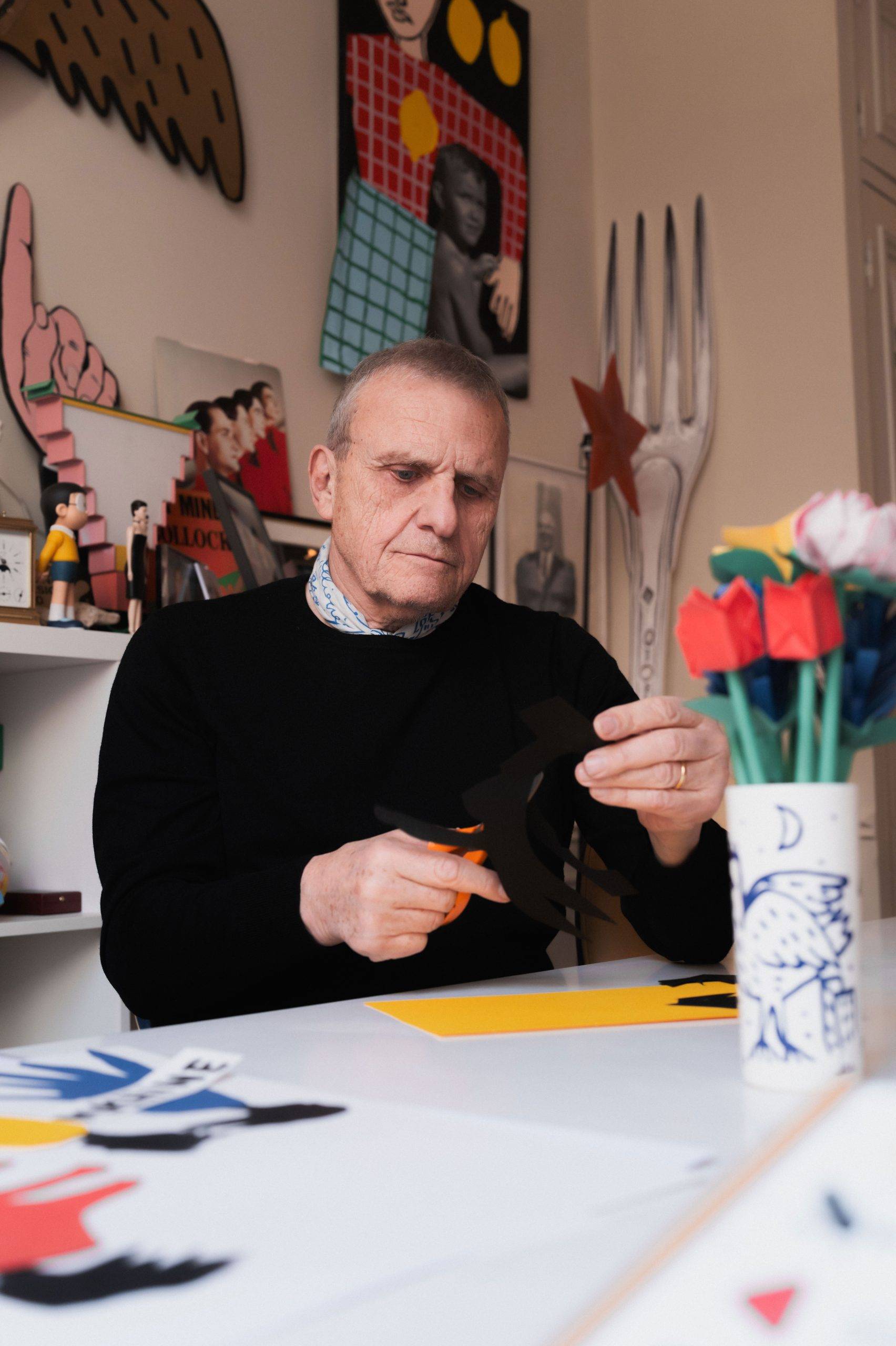
Fashion is usually displayed in a rather impersonal way, but I wanted this exhibition to be completely immersive. So I worked with Lauriane Gricourt and a wonderful scenographer, Pascal Rodriguez, who was a real ally in this adventure. We covered the walls with old blankets and survival blankets, and on another wall, I put up all my graffiti, which we replicated with poems written by my wife. Writing plays a very important role here: literature, poetry, but also music, with a soundtrack composed by Vladimir Cauchemar, kind of like an anthem that will soon be released on Spotify.
A QR code system also allows visitors to listen to you personally talking about your works. Why did you go for this?
Jean-Charles de Castelbajac:
I was striving for a sense of connection, an intimacy between my voice and the visitor’s hearing. I wanted to convey that behind every garment there is a memory, a narrative, a love story or a melancholic tale. This allows tradition and modernity to be blended together through the screens, as this exhibition is also geared towards younger audiences. I loved being able to create a scenography that inspires people and gives hope to a generation. My work is deeply focused on others, and this scenography makes it even more human.
Looking back over five decades of creation necessarily involves a process of selection. How did you pick the 300 or so works on display?
Jean-Charles de Castelbajac:
The exhibition encompasses more than 50 years of work, from my earliest pieces dating back to 1968, to my most recent works, as I am still very active. Together with my archivists and my wife Pauline, who runs my studio, we have done a great deal of selection work to identify the major emotional themes that I have revisited throughout my life. We wanted to show everything, so we organised the exhibition into sections and rooms based on emotion and concept. That’s why I describe the exhibition as a complete overview: I’m showing the first jacket I made at the age of 17, there’s a room on art and fashion from the 1980s onwards, on my collaborations with Ben, Robert Combas, Robert Mapplethorpe, Peter Hujar, Duane Michals, but also another with Palace Skateboards and the Hall Haus collective. It’s a journey of experience and discovery.
Even in your earliest creations, you blurred the boundaries between art, fashion and popular culture. Was this a conscious choice or did it just happen naturally?
Jean-Charles de Castelbajac:
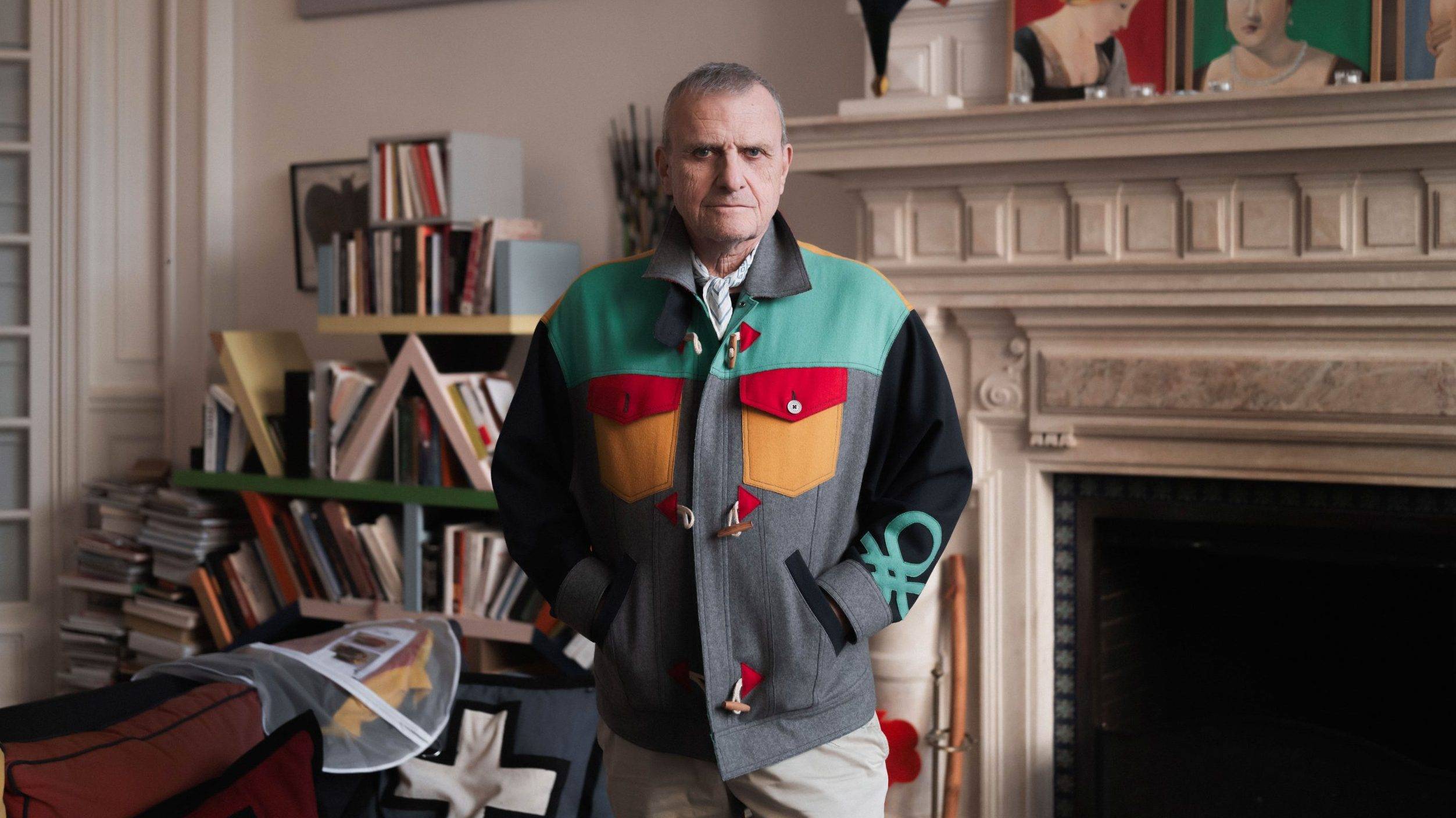
I had and still have a taste for risk. I tend to take the unconventional route and find myself more at ease with counterculture than with institutions. Fashion has certainly been my preferred medium, but I have also done art exhibitions, installations, design, and more. Due to the eclectic nature of my approach and the experimental fields I engage in, I consider my work to be sophisticated, without it necessarily being a work of sophistication. The exhibition explores themes of protection, accumulation and reinterpretation: there are also many rebellious elements, all in fairly simple forms that bring the focus back to posters, flags, dazibao and manifestos.
The exhibition also highlights your numerous collaborations, which are an integral part of your journey. In your opinion, what makes a creative dialogue successful?
Jean-Charles de Castelbajac:
I have always wanted to avoid travelling alone and to collaborate with others: this has been a recurring principle throughout my life. I have always sought to engage in experiences with other artists, manufacturers and institutions such as the Church. When collaborating, I draw inspiration from what I perceive in the other person. If I’m called upon, it’s usually to make things happen. I don’t want my participation to be merely symbolic or ornamental. As I am driven by tradition and history, I often bring these two elements to life through transgressive acts. When I collaborated with the Weston brand, I left the moccasin design unchanged and transformed the shoe into a medieval coat of arms. If I work with a visual artist, for example, I ask myself how our encounter can become an emotional experience. How can we both experience something that will transform our work?
When I started out in the 1970s, collaborations were like an updated form of exquisite corpse. Most of the time, nothing was commercialised; they were simply artistic endeavours. Today, collaborations are much more interesting. With the Hall Haus collective, for example, I created a series of palaver chairs, which come from African culture. I took it and transformed it into a community tool: all the chairs fit together, and they tell a story. Something magical is born from these encounters, and I’m always deeply moved when I see the finished product for the first time.
You are exhibiting the garments you designed for the reopening of Notre-Dame de Paris, a project with strong symbolic significance. How did you find the balance between respect for tradition and creative freedom?
Jean-Charles de Castelbajac:
When I work with the Church, I draw inspiration from my faith, but also from symbols. For Notre-Dame, I worked on the symbolism of the chi-rho, which was once used as a religious sign by Christians, before the cross. For this particular project, I had the opportunity to work with 19M, which is really a historical temple of French craftsmanship. They agreed to work with me on developing the ornamental principles of embroidery. For example, we combined extraordinary needlework techniques with sweatshirt flocking.
If you had to highlight one of your creations, which one would you choose?
Jean-Charles de Castelbajac:
There is one garment that is particularly moving. It is the chasuble I made for Pope John Paul II, now on display in the Treasury of Notre Dame. It is one of many artistic contributions to the Church, all of which have been inspired by colour. During World Youth Day (WYD), John Paul II himself told me that I had used colour as the cement of faith. I am truly moved and honoured to have worked on this chasuble, because since he was canonised, it has become a relic. It is no longer a garment, but a sacred object. These types of large-scale projects inspire me the most.
It was also a way for the public to understand my style and my work over time. Ultimately, it is perhaps the exhibition as a whole that moves me deeply. Our society needs to convey messages to the younger generation, which is difficult nowadays, and I would like this imagination at work to become a first transmission tool.
So the exhibition is a means of transmission, a message to young creators and future generations?
Jean-Charles de Castelbajac:
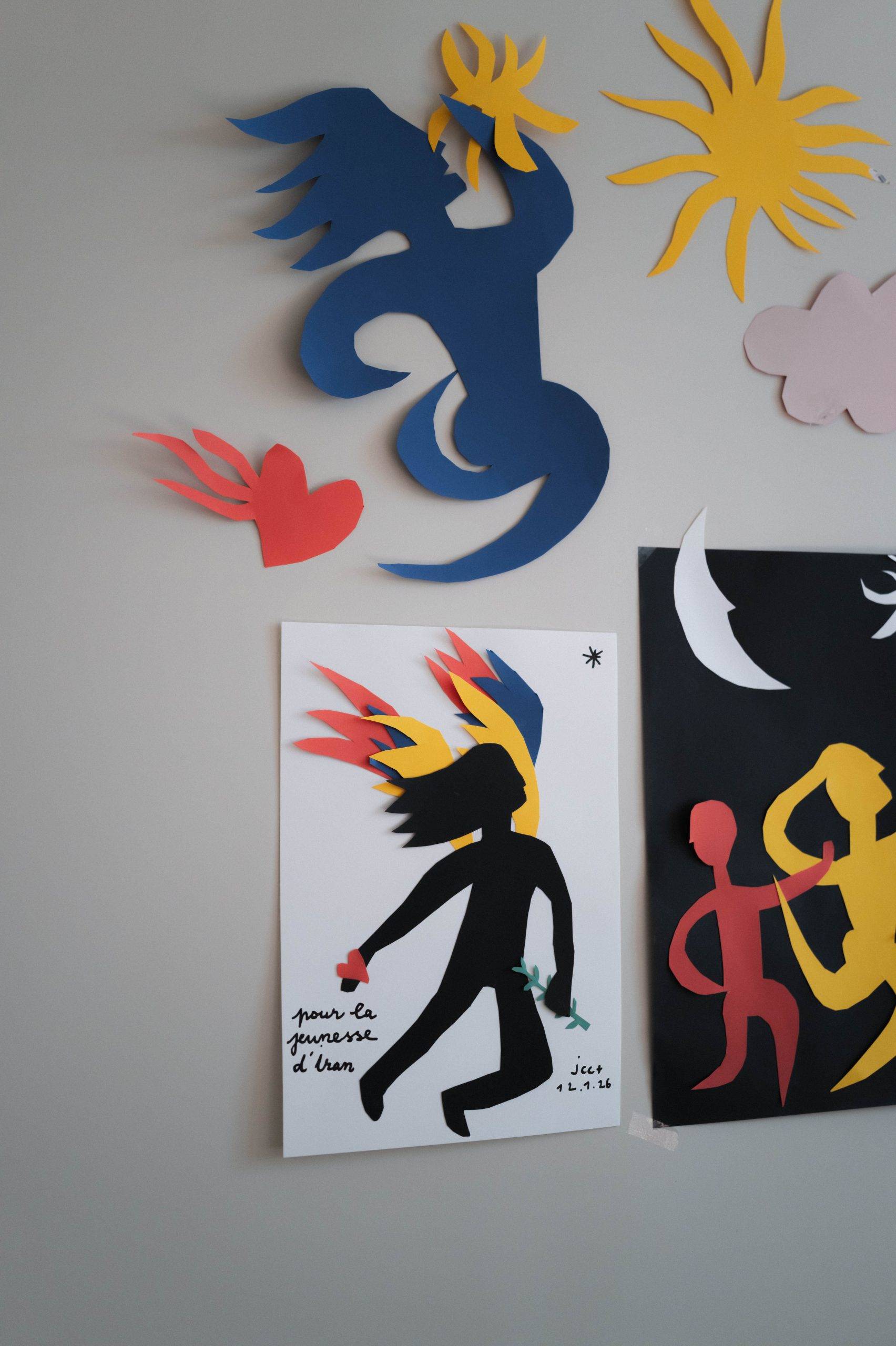
Yes, because I believe that my role in society is now to pass on knowledge. That’s what I try to do, especially through collaborations. I have a lot of experience and I know how to activate and share it. Whenever I work with a performer, musician or singer, I try to bring in elements of pop culture that will contribute, in some way, to the celebration of their art. To name but a few, I have collaborated with a talented young artist and rapper, 3010, as well as with Julien Granel during my exhibition Le Peuple de Demain at the Centre Pompidou, which I am now presenting in Lugano, Switzerland, and which is aimed at children.
What strikes me most is that three different generations come to visit the exhibition, sometimes even four, as there are often very young children. I want to continue to pass on knowledge, inspire the younger generation and pursue this dialogue.
Interview by Agathe Ternoy
Photos: Jean Picon


