


Kathia St. Hilaire
A vibrant tribute to Frankétienne, co-founder of the Haitian literary movement Spiralism
“I wanted to engage with Spiralism not only as a literary movement but as a living, interdisciplinary practice that collapses boundaries between text and image”
Born in 1995 in South Florida, Haitian American artist Kathia St. Hilaire is one of the most compelling emerging figures of her generation and the latest addition to Perrotin’s roster. Drawing inspiration from Vodou flags and her cultural heritage, she has developed an innovative printmaking technique: a complex, materially driven process that has become her signature and a distinctive way of memorialising collective memory.
To mark this representation, Perrotin Paris is presenting The Vocals of the Chaotic Burst, Kathia St. Hilaire’s second exhibition with the gallery and her first solo show in France. The exhibition takes its point of departure from the work of Haitian poet and painter Frankétienne, co-founder of the Spiralism movement, who passed away a year ago. Bringing together a cohesive body of paintings, the show explores layered narratives connected to the dictatorship of François Duvalier and its lasting cultural and psychological impact.
On the weekend of the exhibition’s opening, we had the pleasure of meeting Kathia St. Hilaire to learn more about her practice and the making of this exhibition…
The paintings in The Vocals Of The Chaotic Burst are mesmerising yet embody the voices of turbulent times and are inspired by Frankétienne’s novel Ready to Burst. What drew you to this novel as a point of departure for the exhibition?
Kathia St. Hilaire:
I was intrigued by how Négritude, Noirism, Magical Realism, and Spiralism all emerged as aesthetic and political responses to colonial erasure, seeking to recover suppressed histories and re-center Black and postcolonial lived experience. While Négritude affirms Black consciousness, Noirism politicizes cultural recovery in Haiti, and Magical Realism destabilizes Western realism to make space for myth and historical trauma, Spiralism goes further by formally rejecting linearity itself and embracing chaos. Under François Duvalier’s dictatorship, Frankétienne subtly camouflaged this Spiralist approach in Ready to Burst in order for the work to be published and circulated in Haiti. At its core, the text explores how he experiences and survives his own life under authoritarian rule. I was particularly interested in Frankétienne’s attempt to sustain a literary career from within a dictatorship choosing to remain in Haiti rather than leave and how Spiralism becomes both an artistic method and a strategy of resistance.
You also incorporate two phrases from Frankétienne’s novel directly into the paintings. Why was it important for these words to appear materially and visually?
Kathia St. Hilaire:
Inspired heavily by Frankétienne’s writings and paintings, I wanted to honor the founder of Spiralism by incorporating his words directly into my own paintings. In doing so, I wanted to engage with Spiralism not only as a literary movement but as a living, interdisciplinary practice that collapses boundaries between text and image. For this body of work, I selected two phrases:
Every day I employ the dialect of mad cyclones
I speak the lunacy of contrary winds
Just like Ready to Burst, your work incorporates autobiographical fragments, like the use of magazine advertisements and discarded beauty product packaging. What role do these personal materials play within the broader conceptual framework of the exhibition?
Kathia St. Hilaire:
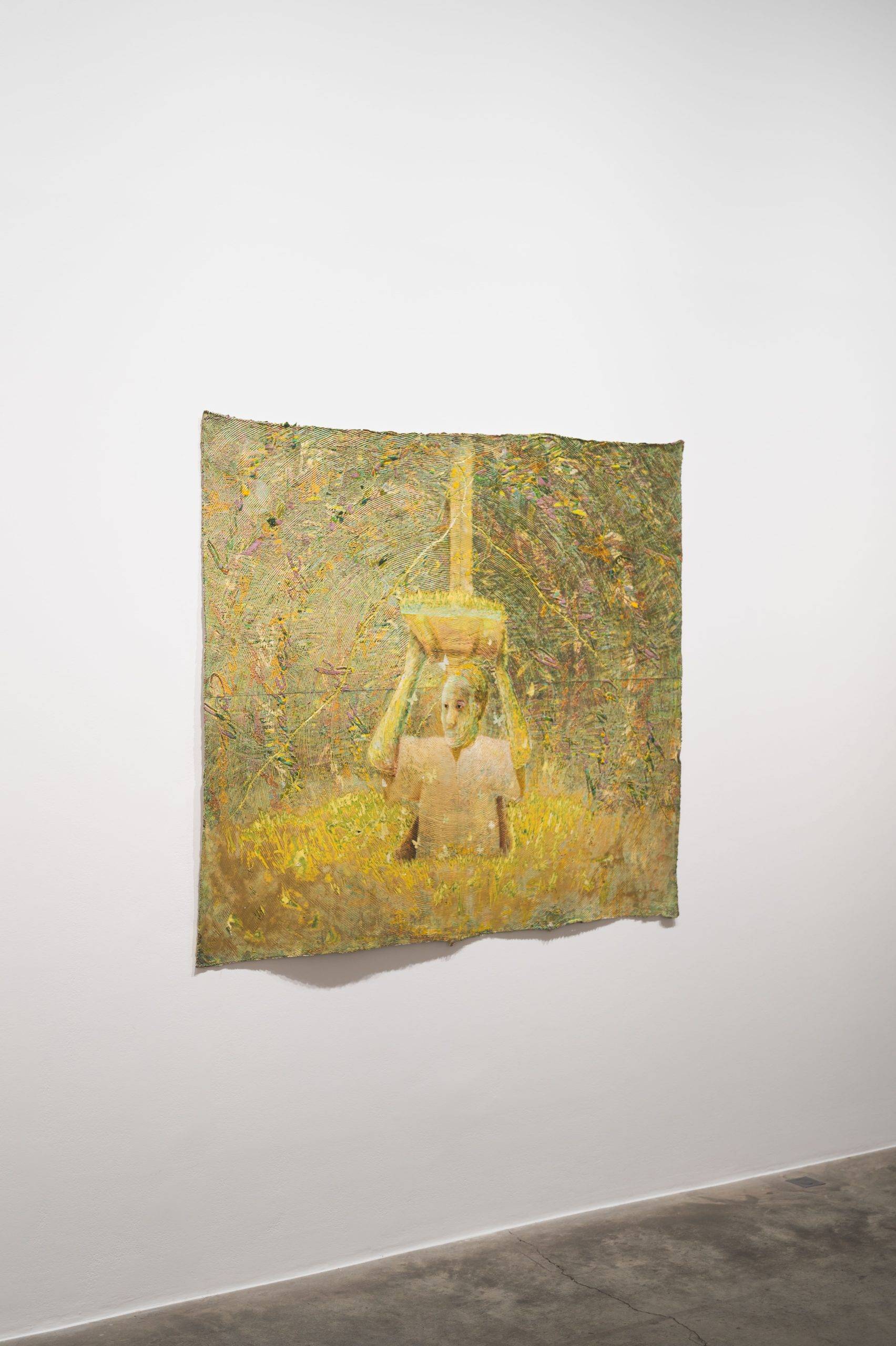
Materiality plays a central role in how I construct and communicate narratives in my work. While I often use beauty products to address the complexity of social color, I became increasingly interested in barbed wire as a material and symbol. While looking at photographs from the Duvalier regime in Haiti, I began to explore wartime photography from other regions during the same period. I was particularly drawn to images of World War I trenches and the repeated presence of barbed wire. Extending my Spiralist lens to the Western Front, I became interested in barbed wire for its coiled, spiraled form, as well as its recurring historical use across warfare, immigration, and violent occupation. In this work, the material itself is physically imprinted into the canvas, allowing barbed wire to function not only as an image, but as a trace of lived and embodied history.
Is this exploration of wartime in a broader sense also connected to Frankétienne’s work?
Kathia St. Hilaire:
In Ready to Burst (1968), the first Spiralist novel, Frankétienne repeatedly fractures his protagonists’ narrative through autobiographical intrusions, inserting lyrical eruptions into an already unstable structure. Dreams, anecdotes, and poetic fragments accumulate to form a portrait of the author’s formative years as a marginalized youth in Haiti. Within this deliberately choreographed disorder, the ordinary and the extraordinary collapse into one another, and autobiography often registers as more surreal than fiction itself. As the narrator recalls reports of distant wars fought across faraway shores—specifically World War II—global conflict enters the novel not as linear history, but as fragmented memory, filtered through rumor, radio, and imagination. World War II thus becomes part of the psychic landscape of life under dictatorship, linking international violence to local conditions of fear and precarity in Haiti.
While looking at photographs from the Duvalier regime in Haiti, I began to take an interest in wartime photography from other regions during the same historical moment. In Ready to Burst, Frankétienne also references the Vietnam War, which unfolded alongside Duvalier’s dictatorship (1957–1971), further collapsing geographic distance and historical sequence. In this work, I depict a Vietnamese civilian emerging from a tunnel constructed to evade U.S. forces during the Vietnam War. By placing Haiti, World War II, and Vietnam within the same Spiralist framework, I explore warfare as a continuous, global condition rather than a series of isolated events. Across these contexts, everyday civilians are forced to adapt to shifting conditions of danger, surveillance, and instability. In this sense, I understand Spiralism as extending to the Vietnamese figure I depict, whose lived chaos mirrors the turbulence experienced by Haitians under Duvalier and by populations shaped by the long afterlives of World War II.
Your work draws on a wide range of historical and visual sources. How do you balance research and creation?
Kathia St. Hilaire:
I often begin with material research and readings that interest me, though there is no fixed order to my process. At times, the material itself leads me toward specific themes and historical inquiries; at other moments, the research and historical context guide my choice of materials. This back-and-forth reflects a non-linear way of working, where form, content, and history continually inform and reshape one another.
Trained as a print-maker, you have developed a highly complex technique that combines multiple media: reduction relief printing. How did this method evolve, and what does it allow you to express that other processes might not?
Kathia St. Hilaire:
Essentially, I am drawn to Vodun flags—sacred, sequined banners used to honor the spirits, which inspired me to reinterpret these ceremonial textiles through reduction relief printing. At the same time, reproductions of mid-19th-century French floral textiles around my home, along with French Impressionism, have influenced me to merge these visual languages. My process begins with a large drawing transferred onto linoleum, from which I carve small sections and print fifty or more layers in large editions on a variety of surfaces, including paper, beauty product packaging, industrial metal, fabric, and tire rubber. Each layer requires careful attention to ink viscosity, pressure, and surface, producing dense, textured works that I further develop through sewing, sanding, painting, collaging, carving, and even incorporating barbed wire.
While I often start with a quick sketch or partial copy of an image, my process relies heavily on small-scale material experimentation and historical research. My interest in using diverse, found materials, like tires, packaging, and metal, stems from wanting to repurpose objects that shaped my life but are typically discarded after use. Multiplicity is central to my practice: it underpins the substrata of my paintings, allowing me to experiment with different mark-making, collage techniques, and ultimately take significant creative risks.
How much is planned in advance? Does the final image determine the materials, or do the materials themselves guide the image?
Kathia St. Hilaire:
I often begin with a general, vague idea of what I want to create, but I discover the work fully through a series of material explorations and sketches. When I’m working toward a deadline, I usually try to plan two years in advance to allow enough time for experimentation. On my own timeline, however, I work on projects more intermittently, moving back and forth between ideas, materials, and processes as they evolve.

What is your favourite part of the process?
Kathia St. Hilaire:
I would say that collecting materials and problem-solving are the parts I enjoy most. They bring me a sense of calm, which is especially important since I tend to be an anxious person.
Although the works are displayed like paintings, they are three-dimensional, materiality is key, and you have also produced sculptures in previous exhibitions. Do you see your practice evolving toward more immersive or spatial forms?
Kathia St. Hilaire:
I hope so, but I remain very open to the directions my work might take. Right now, Japanese printmaking techniques and working with sugarcane are two ideas I’m exploring for a new project.
Interview by Cristina López Caballer
Photos: Jean Picon


