


Diana Markosian
A Visual Language to Navigate Identity
“The line between public and private wasn’t about protecting comfort—it was about protecting integrity“
One of the standout names from the 56th edition of the Rencontres d’Arles is undoubtedly that of Diana Markosian. For her first participation in the renowned festival, the American artist presented Father, a deeply personal series exploring and attempting to rebuild her relationship with her father. At the crossroads of documentary, personal diary, and intimate journey, this poignant work earned her the Prix de la Photo Madame Figaro Arles 2025. We had the pleasure of speaking with her to uncover the multiple layers behind this remarkable project.
Congratulations are in order! Back in 2020, you were scheduled to participate in the Rencontres d’Arles with your first monograph, Santa Barbara, but the exhibition was cancelled due to Covid. Five years later, you’re here with the second instalment, Father, which has just earned you the Prix de la Photo Madame Figaro Arles 2025. How does it feel?
Diana Markosian:
Thank you so much, I’m honoured! Indeed, I didn’t get the chance to exhibit my work in Arles in 2020 because the show was cancelled due to Covid. So in a way, being here now feels like a long-awaited moment. It’s very meaningful to finally present my work in person at Rencontres d’Arles, especially after such an unusual start.
How has your approach (both in terms of narrative and visual) evolved between Santa Barbara and Father? How do they inform each other?
Diana Markosian:
Both projects are deeply personal, but they take very different approaches. Santa Barbara focused on my mother’s story and our family’s immigration experience. It was a reconstruction—I collaborated with a casting director, a writer, and a group of actors to reimagine and stage key moments from our past. In contrast, Father was about navigating a more ambiguous, fragile space: the process of exploring and attempting to rebuild a relationship with a man who was meant to be my father.
While Santa Barbara was rooted in narrative structure and performance, Father leans into emotional immediacy and the complexity of presence and absence. Both works inform each other—they’re connected by a search for identity, belonging, and the attempt to make sense of fractured family ties.

What triggered the decision to embark on this journey about your dad?
Diana Markosian:
I didn’t want to be defined by the absence of my father, or by the unresolved feelings I carried around him. There was a point where I realised I needed to confront that silence—not just to understand who he was, but to reclaim that part of my story. I wanted to find him and face whatever truth was there, whether it turned out to be painful or healing. It was about taking ownership of that experience, rather than letting it remain a void.
Would you say that having a lens between you was also a sort of protective shield?
Diana Markosian:
Not really a shield—if anything, the lens was a way of healing and reconnecting. It gave me the means to confront him directly, but also to build something together. Having the camera there created a shared experience—it gave us a reason to spend time, to engage, and to be present with each other in a space that felt intentional. It wasn’t about distance or protection—it was about finding a language we could both participate in.
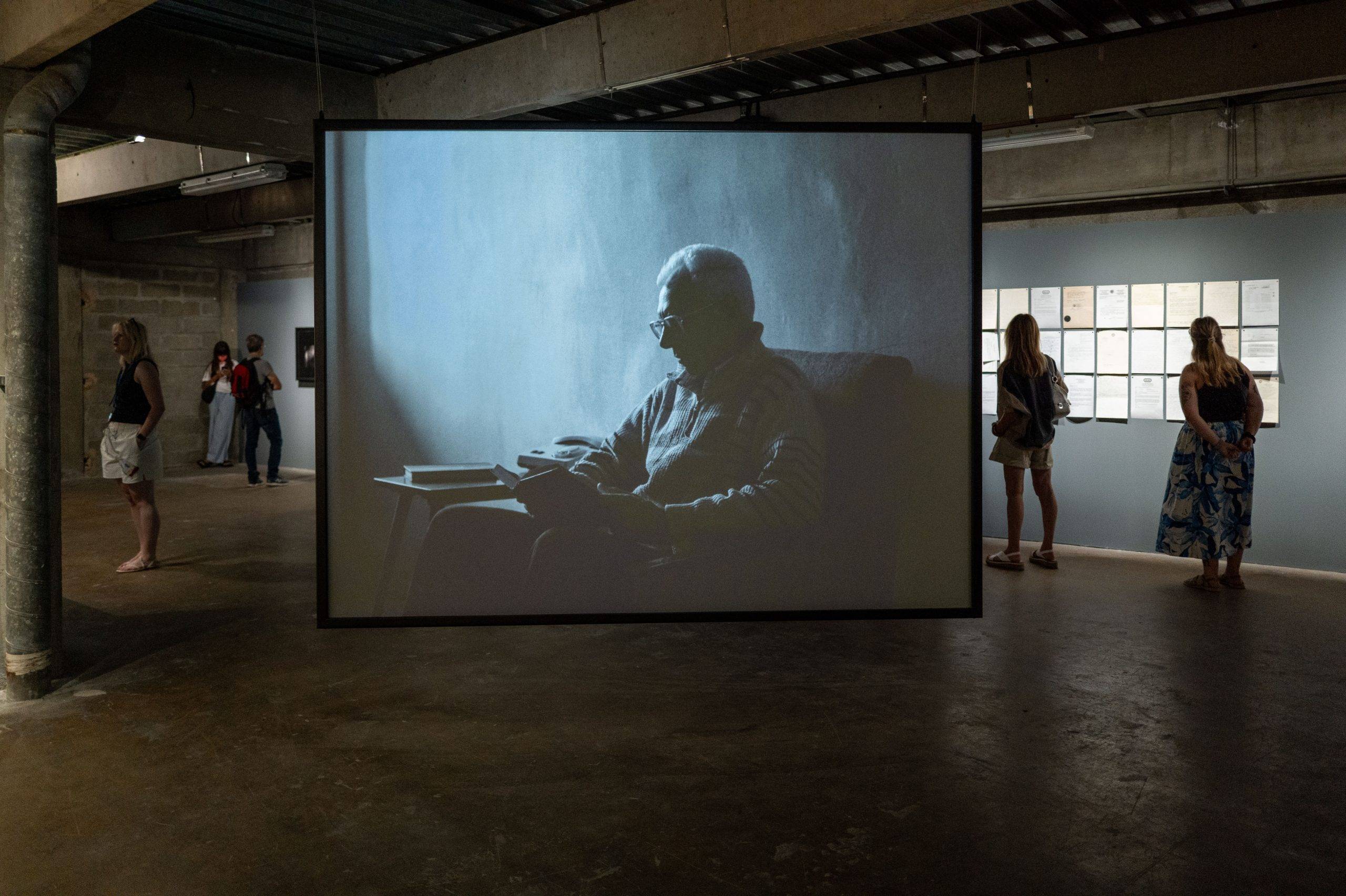
Your series is introduced by a short film. What does the cinematic format allow you to explore further than photography alone?
Diana Markosian:
Film brings the experience to life. It adds movement, voice, breath—elements that go beyond what a still image can hold. Especially for Father, it allowed for a deeper emotional dimension. You see the pauses, the hesitation, the small gestures—all the things that give meaning and complexity to the relationship. It helped transform the encounter into something shared and alive, not just documented.

The series can be seen as a documentary, a personal diary, a fictional tale, an artistic piece… Where does it stand for you?
Diana Markosian:
For me, it’s a discovery. In finding my father, I found someone else who had carried a version of this pain alongside me. The work doesn’t sit neatly in one category—it’s part documentary, part personal diary, and part emotional reconstruction. It’s less about defining the form and more about capturing the complexity of that encounter. The process of making it was as much about understanding him as it was about understanding myself.
We are dealing with a deeply personal and emotional story, nevertheless exposed to the world to discover. How does one draw the line between what to show and what to keep private? Was this something you navigated alongside your family?
Diana Markosian:
I wanted this work to be as vulnerable and honest as possible—otherwise, there wouldn’t have been a reason to make it. For me, the power of the project came from that raw openness. Of course, there were moments of hesitation, and I was mindful of what to include, but the instinct was always to lean into truth rather than shy away from it. I did navigate some of this alongside my family, but ultimately, it was a personal reckoning. The line between public and private wasn’t about protecting comfort—it was about protecting integrity. If something felt performative or disconnected from the emotional core, it didn’t belong in the work.
The title of your upcoming project, “The Confession” is quite evocative of emotionally-charged storytelling. Can you give us a hint of what it would be about? Should we expect some sort of cathartic revelation?
Diana Markosian:
The Confession comes in the aftermath of a relationship—one that left me searching for clarity, forgiveness, and healing. In the wake of that ending, I began travelling across the world, stepping into churches and confessing to priests, not always for absolution, but to be heard. It became a way to process grief and guilt through the structure of ritual and spiritual intimacy. It’s not about religion in a traditional sense—it’s about vulnerability, seeking connection, and the hope that saying something out loud, even to a stranger, might offer a kind of release. So yes, there is a cathartic element—but it’s quiet, slow, and deeply personal.
Interview by Cristina López Caballer
Photos: Jean Picon et Michaël Huard


