


Elfie Semotan
Beyond Glamour: Rethinking Fashion Through the Lens
“You need to find what’s yours, and for that, you’re going to have to look around, and ask questions”
We caught a glimpse of her last June, when she took part in the inaugural group exhibition at BASTIAN Paris. This month, Elfie Semotan returns to the French capital to present her very first solo show in Paris, the same city where she briefly appeared as a model before devoting herself fully to photography. Eager to break away from the conventions of fashion and advertising imagery, she made a breakthrough in the 1960s and became one of the most coveted photographers of our time, whose work continues to resonate today. Just ahead of the exhibition opening, we met her at the gallery to discover the stories behind her photographs and talk about improvisation, subverting ideals, and the importance of paying attention to what’s before our eyes.
This is your first solo exhibition in Paris, where you first started as a model. How does it feel to be back here, this time behind the lens?
Elfie Semotan:
It feels wonderful! I never liked being in front of a lens, but when I first came to Paris, I had no money, so modelling was just an easy way to make money fast. Once I could devote myself to photography, I never even thought about doing that again.
How did that experience shape your practice as a photographer?
Elfie Semotan:
What I experienced as a model was that photographers were mostly men who had no idea of what they were asking a person to do. So I’d find myself standing there and thinking, well, what should I do now? Should I jump? Should I stay still? Also, how do I look? So I learned a lot about modelling, photography, and many other things.
I knew how it felt being in that position, so when I’m behind the lens, I always try to comfort people. I talk to them and help them forget about their nose, their chin, or whatever they are worried about. Otherwise, it makes them awkward and stiff. Beauty is one thing anyway; everyone has an idea about beauty. At that time, however, the notion was much more restricted.
Indeed, in this exhibition, we see beauty in all its heterogeneity, from fashion editorials to personal projects and striking portraits. How did you conceive the show?
Elfie Semotan:
The selection was actually entirely done by the curator, Sebastian C. Strenger. Although he didn’t have such extensive knowledge of my work, he was very precise in his selection, and I find it very good. I enjoyed seeing what caught his attention, and I’m very happy with the result because he picked them for the reason I made them for.

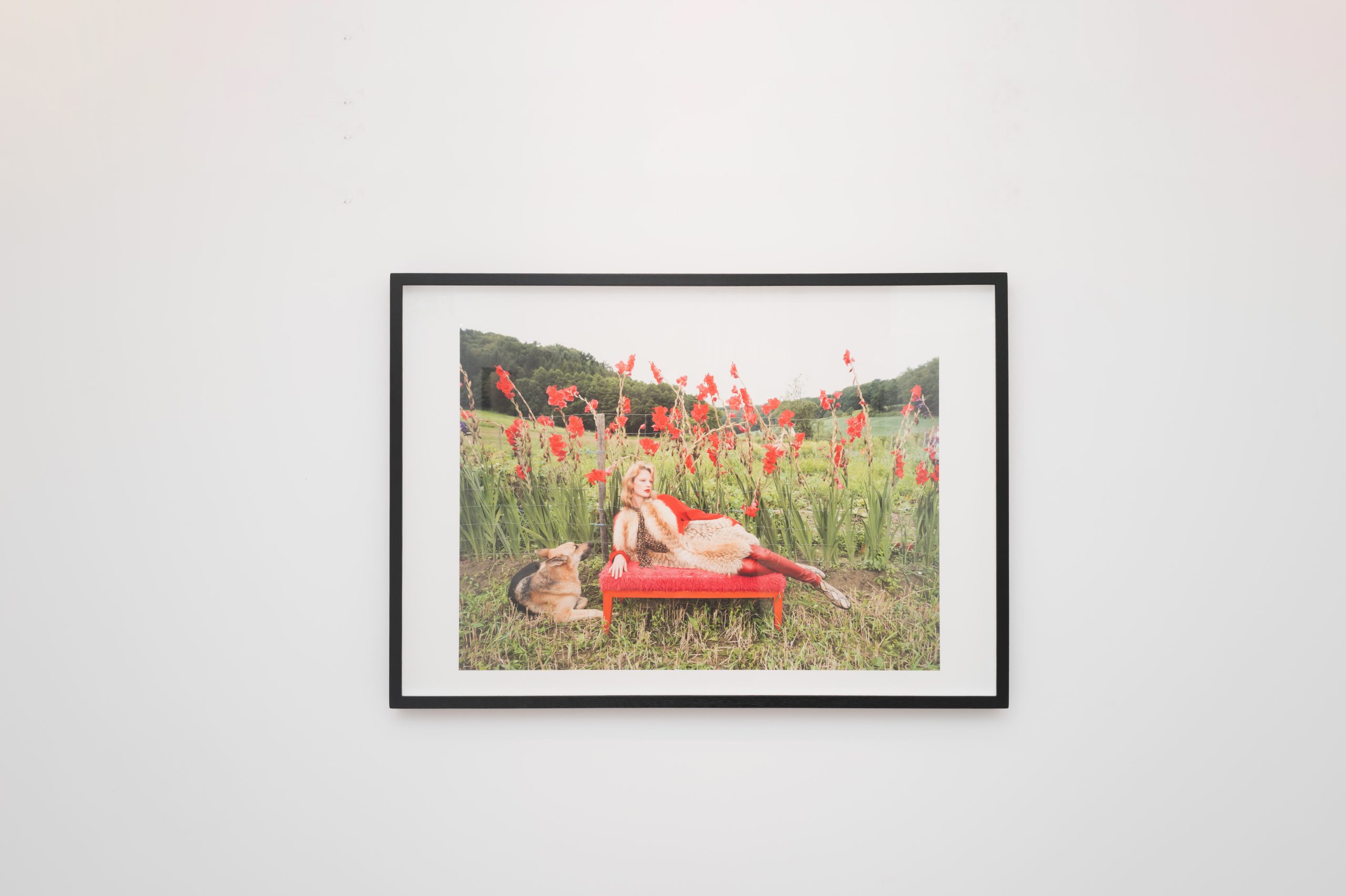
So the curation revealed connections in your work you hadn’t seen before?
Elfie Semotan:
You could say so, yes. It also speaks about the improvisation and playfulness behind my photographs. For instance, BGLD started with a fur coat we were carrying in a van filled with kitschy palm trees. Driving in the countryside, I found a beautiful field and thought of staging the shoot. My stylist brought a small piece of furniture, which stood out in stark contrast against the background, then suddenly the model’s dog entered the frame, and it all just came together. He naturally stood there, making the image even more abstract but also playful. These accidents are often what make an image work.
Was it precisely by introducing these accidents and free improvisation that you tried to challenge traditional fashion photography?
Elfie Semotan:
When I did fashion, and I rarely do it now, I wanted to transform the world of fashion. I didn’t want to go further into the luxury and glamour. I wanted to depart from that aesthetic because everyone was doing the same.
Take the series Life Moves Fast, New York (1999/2008). I did it for i-D, which at the time was doing something very adventurous in terms of themes and photography. The theme for the editorial was “moving”, but instead of making the model move, I made her sit and make everything around her bring in the movement. We used up all kinds of stuff, a nylon bag, a toy racing car, even a dog that comes in one of them. I was also inspired by Jeff Wall’s photo work Milk (1984), so I had the model pour out milk. My assistants were so brave, you can imagine it took many shots to get that right, and it was pouring rain, one was scared we would die from an electric shock. The model was also great and beautiful, one of the best I’ve worked with.
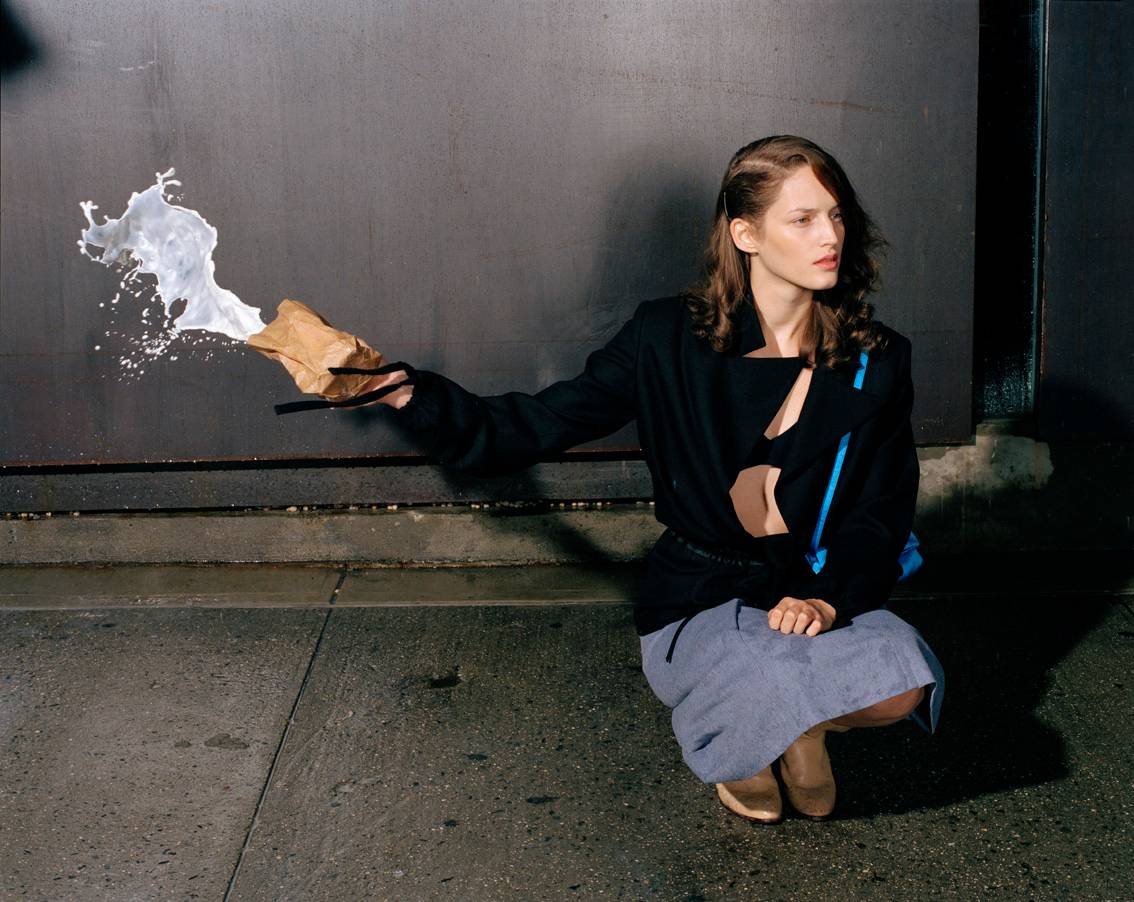
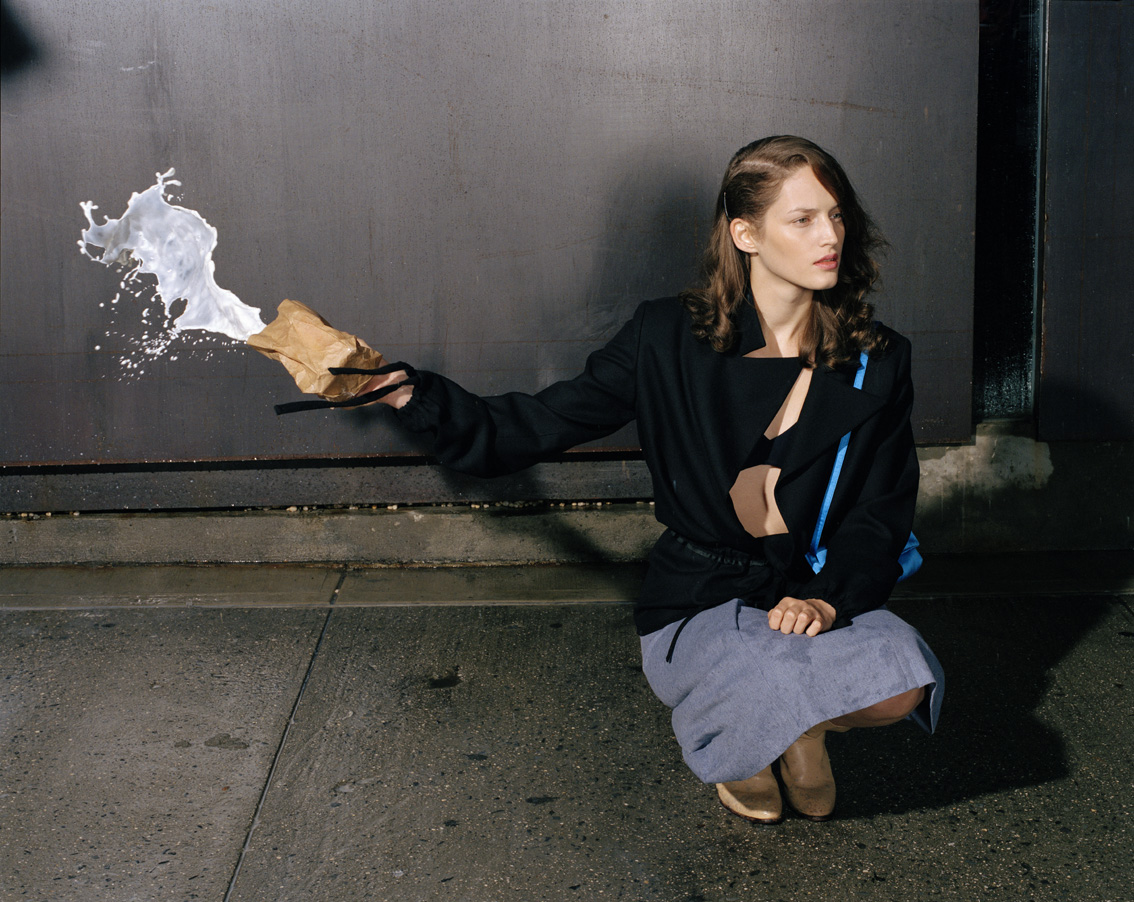
There’s clearly a strong desire throughout your work to go against stereotypical notions of beauty, particularly in how women are portrayed.
Elfie Semotan:
Fashion very often is, and has always been, quite… specific. For me, it was always important what kind of role women have to play in fashion and in advertising. I disliked the normative one intensely, and I didn’t want to repeat any of it. I’m not interested in taking photographs that are just about luxury and “sexiness”, not because I’m a woman, but because I don’t think it’s necessary.
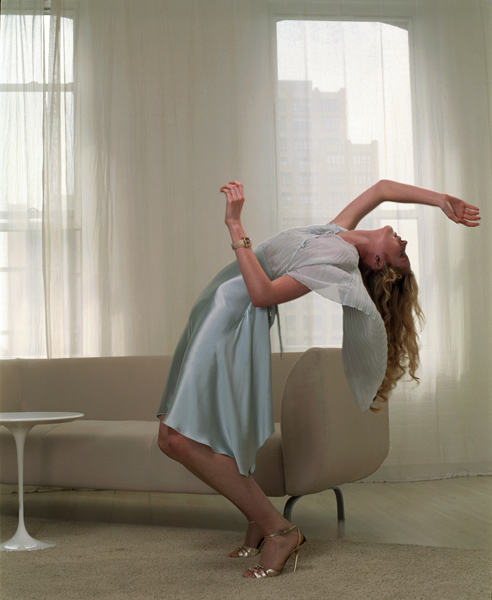
That’s also why I did a beautiful jewellery shoot for Vogue Gioiello in 2023, where I purposely decided to conceal the model’s face. Taking some inspiration from Roy Lichtenstein, whose work I admire deeply, I used yellow plastic to make a wig with a sort of ponytail. I photographed the model from behind, so the only skin exposed is the shoulder that exhibits the necklace.
Possibilities are endless, and you can make it look equally good and elegant while breaking away from the usual visual surroundings. Of course, you need to think of aesthetics, there must be somewhere, but you can take unusual settings and stories. There are plenty, and it is much more exciting.
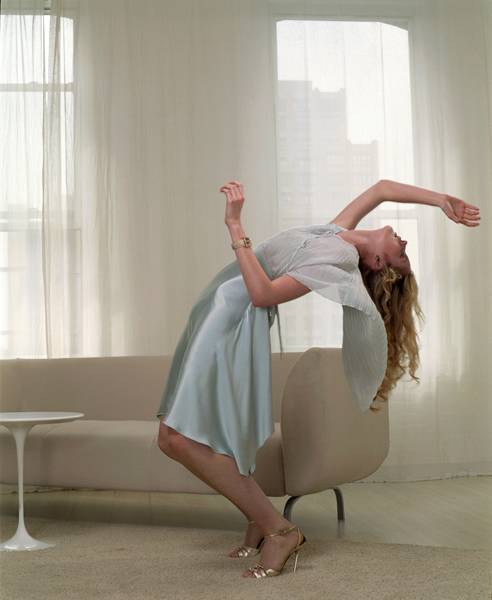
I guess there’s quite a story behind the Hysteria series too…
Elfie Semotan:
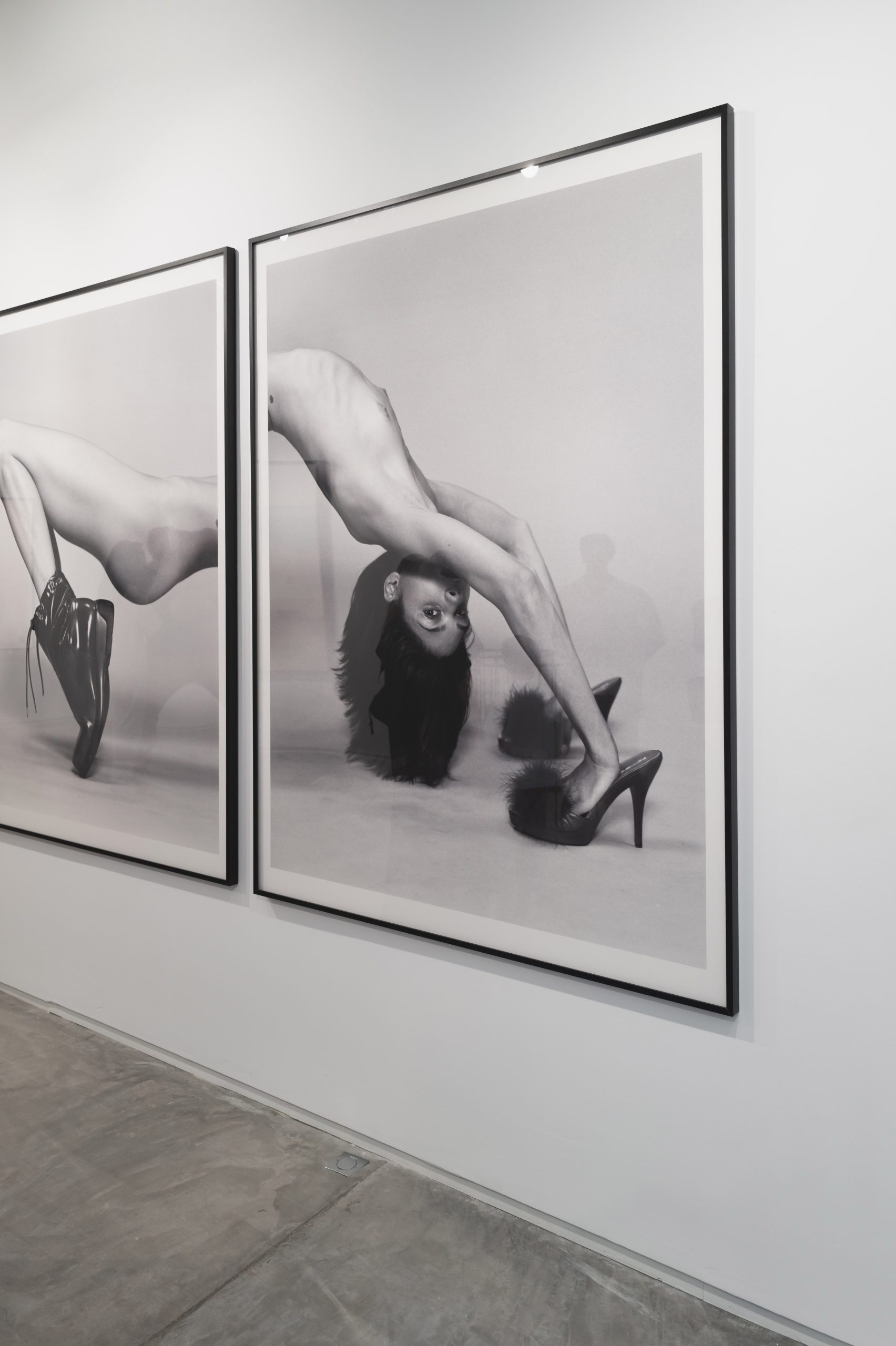
Quite a story, indeed. It began after reading a book by a French author who wrote about treating so-called “hysterical women.” He gave names to the postures they made during their fits, like the “hysterical bow”, and turned them into a kind of theory. I thought, “What a wonderful feeling for a man doctor to have all his hysterical women, and just categorise them as such” I decided I wanted to tackle the subject myself too. I also saw an exhibition in Austria showing archival photographs of sick women, and thought of introducing the theme into the fashion world.
After making the series, I read a biography of Louise Bourgeois and books from two other women, who had all read the theories about the so-called hysterical women. Like me, they seemed to think this man had it quite easy, building theories around nervous women without truly understanding them. That led me to make a second series on the subject.
As if in response to that, next to the Hysteria series, there’s a photograph portraying seven defying women…
Elfie Semotan:
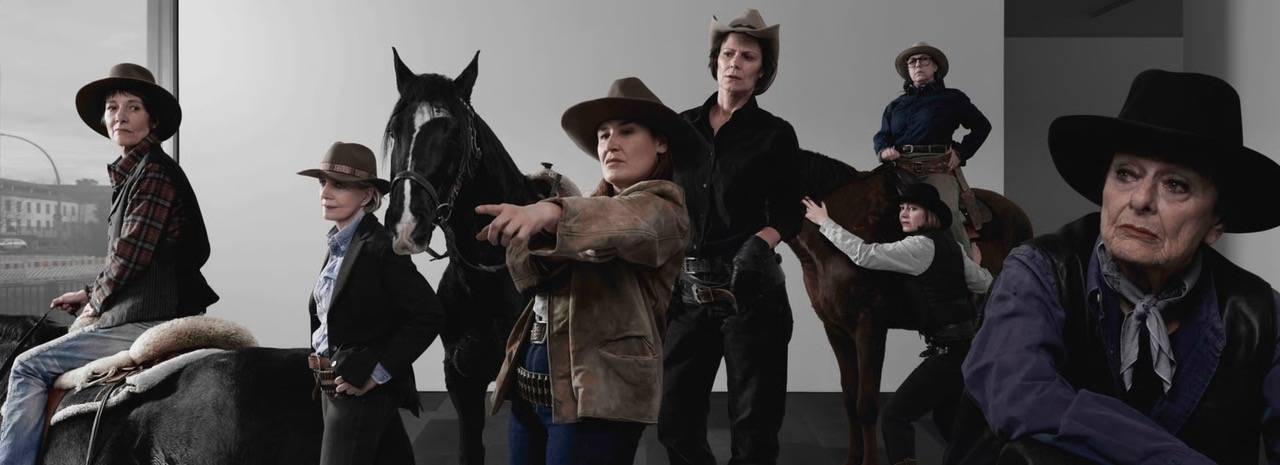
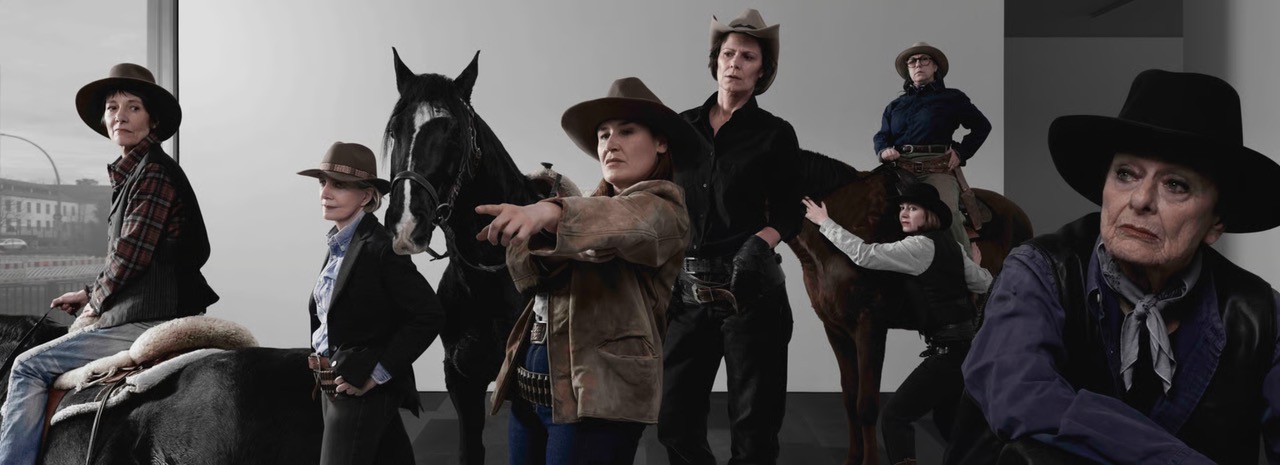
Yes, The Magnificent Seven +. The gallery was preparing the inaugural exhibition of their new Paris space, and the curator, Sebastian C. Strenger, approached me with the idea of staging a version of the 1960 Western film The Magnificent Seven, but with women. He wanted to feature seven women who are reshaping the art world today, and suggested including me as the eighth, hence the “+” in the title.
It was a great concept, but logistically tricky. His original idea was to stage all seven women with five horses in the BASTIAN Gallery in Berlin. It’s a big space, but not quite big enough for that scale of shoot. So we had to adapt: I ended up photographing the women separately and working with just three horses. Later, we put all the images together to create the final composite.
Has working digitally (at the time) or with post-production tools like Photoshop changed the way you approach photography?
Elfie Semotan:
Photoshop is a bit tricky for me, so I got help from my assistants to combine the portraits for The Magnificent Seven. But yes, post-production tools were quite helpful. It would have been impossible to stage the women and the horses in such a tiny location, so I shot them separately, and then my assistant helped me put together the final piece.
In the same way, I embraced digital photography when it first appeared. At first, it was a bit complicated because the colour was off, but it quickly improved, and now it works miracles. It’s also great in the sense that photography has become more accessible for people. That said, some tend to use it very carelessly, which is a pity.
What do you consider a careless use of photography?
Elfie Semotan:
I mean that people just photograph anything. No matter if it’s a fruit, a dog, a hat or the meal they’re about to eat, and send it to others. It’s not only carelessly done, it’s carelessly sent to everybody. I don’t want to be constantly fed pictures of people with their friends or see posts about what people are eating. Like God, don’t you have anything else to do? Something more interesting? (laughs)

How does one know when it is worth clicking the shutter?
Elfie Semotan:
When it matters. In that sense, having started with analogue photography indeed helps train the eye. Because, whereas now you’re getting a picture no matter what, the analogue is restricted and forces you to make the shot matter.
Also, being exposed to screens at an early age is something we should try and avoid, because it creates really bad habits. You stop realising and paying attention to your surroundings, your brain develops differently, and you miss out on some things.
I take it you’re not a great fan of AI…
Elfie Semotan:
Well, I think it is very interesting if you have to find something or make comparisons. As a searching machine, wonderful, but cannot invent anything new. It simply takes pieces and bits from what people did and puts them together.
Some people like it, find it fun, but I’m not interested in it. I can put things together, too! The more so, I can do it in a unique way, transform it and make it mine.
The question then would be, is the public discerning enough to be able to share that approach?
Elfie Semotan:
That’s the problem. But they will find out for themselves, maybe. You can do lots of different paintings that many will find boring or don’t realise what’s about them, but then a few will, always.

A piece of advice to a young photographer?
Elfie Semotan:
I think what is very difficult is to find out what you really like. To find what’s yours. So you need to look around and ask questions: What do you see? What is interesting to you? When you photograph something, realise why you chose one thing and not another. Is it because it is beautiful, or interesting, or perhaps because you have questions about it?
There are lots of things you can use, but you have to know what is really yours. And I think it is very difficult because now it’s so easy to take a picture, just push a button, right? But people have to learn to look at photos and to see what is different.
Is there any recent work that has inspired you in that sense?
Elfie Semotan:
Today! I went to see the Wolfgang Tillmans exhibition at the Centre Pompidou. He’s a wonderful photographer and a wonderful teacher in the sense that he can photograph anything, but transform it, so it’s no longer just anything. He manages to make his subjects interesting and make us interested in them. When he decides to photograph something, it is to show that it’s a finality; that’s where he makes the difference.
Again, you have to know what you are photographing and why. Because you can take a horrible light that makes your nose completely deformed and doesn’t embellish it. But if you are aware of it, and still make the conscious choice, it already points to a reason. So I think you can do everything, as long as you know what you are doing, and this is difficult. You have to learn a bit.
Interview by Cristina López Caballer
Photos: Jean Picon


